The Collection
THE PAINTED SOUND
Klaus Kother • ROX Fashion • TARA Couture • Painted Sound
Introduction — The Painted Sound
“The Painted Sound” is a cycle of works in which guitars become resonating bodies of visual energy. Wood, lacquer, metal, and pigment merge to create narrative soundscapes: memories, explosions, rituals, urban fragments, natural poetry, baroque drama, cosmic spheres. Each guitar is a universe unto itself, but when combined, they create a polyphonic work of chaos, mythology, light, nature, pain, departure, and expansion.
The cycle is divided into two major movements :
• Cycle I (guitars 1–10): Origin, identity, myth, emotion, memory
• Cycle II (guitars 11–15): New beginning, insight, nature, fire, transformation, cosmic ascension
Together they form a visual oratorio, an epic work of color, light, texture, and symbolism.
Cycle I – The First Orbit (1–10)
- 1 - Les Paul – The Birth of Chaos
- 2 - Stratocaster – The Dance of Light
- 3 - Akustik – The Memory of Wood
- 4 - Telecaster – The Rust of Time
- 5 - Explorer – The Divine Chaos
- 6 - SG – The Dark Romance
- 7 - Les Paul – The Stardust Frequency
- 8 - Akustik – The Phoenix Ember
- 9 - SG – The Rebel Pulse
- 10 - Archtop – The Carnival of Memory
Cycle II – The Ascending Cycle (11–15)
- 11 - Les Paul – The Veins of Creation
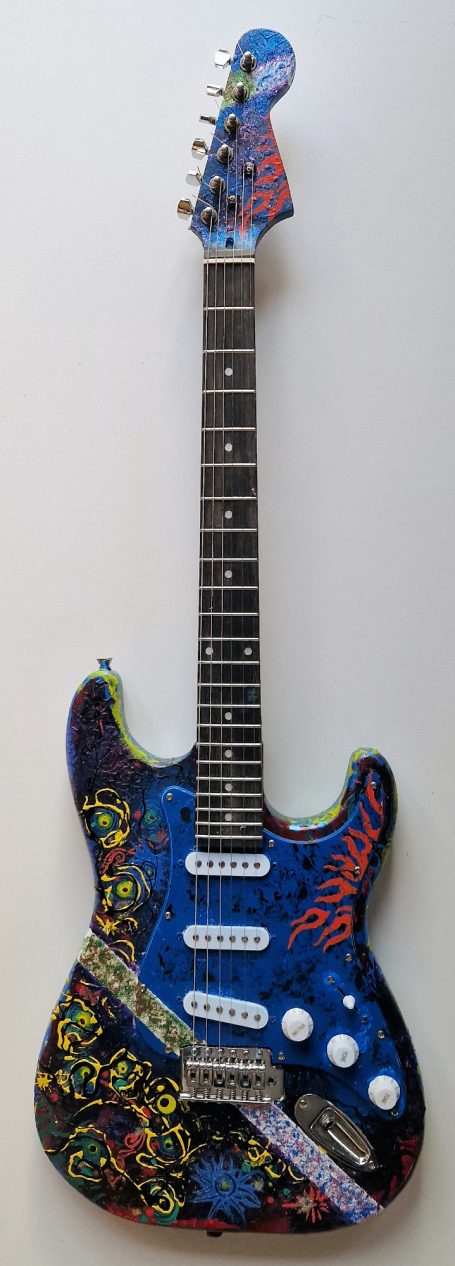
- 12 - Stratocaster – The Eyes Within the Night
- 13 - SG – The Jungle Whisper
- 14 - Archtop – Barock Fire
- 15 - Les Paul – Lunar Palm Ascension
Custom Circle – The Dialogic Extension (16–20)
- 16 - Stratocaster - “Stellar Covenant”
- 17 - Acoustic Western – “Golden Resonance”
- 18 - “Origin / Painted Core”
Extensions & Sculptural Works
- 19 - “Dorli” (Hopf Travel Guitar, ca. 1950s–1960s)
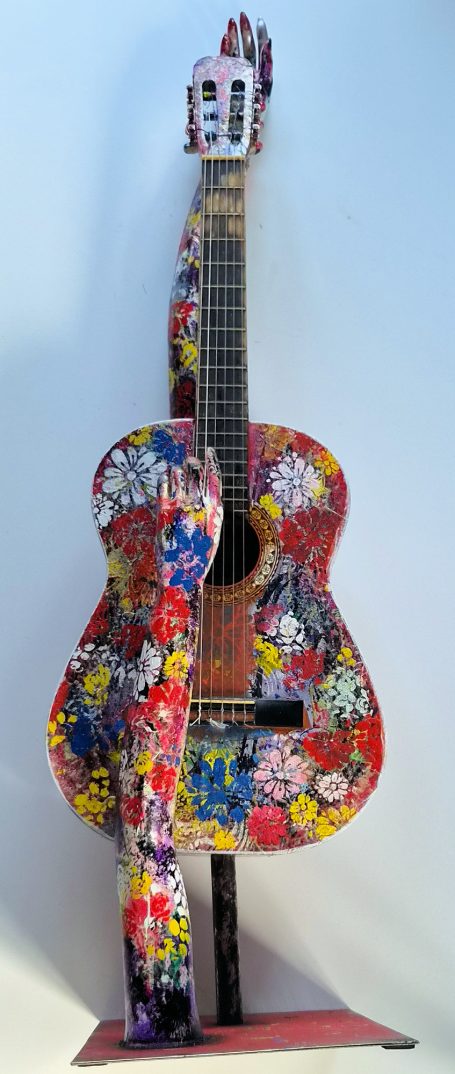
- 20 - Sculptural Work I - The Keeper of Sound
Public & Referential Works
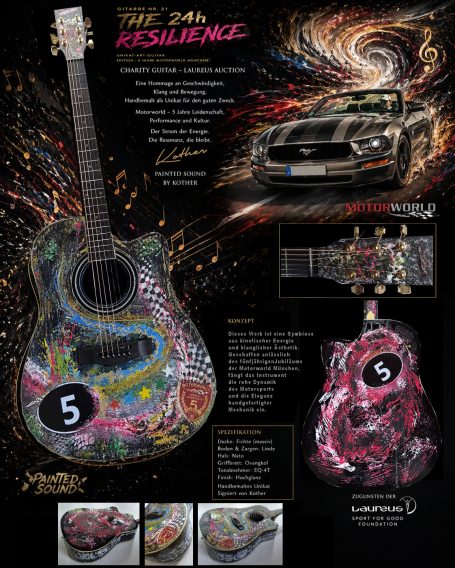
- 21 - „THE 24h RESILIENCE“Unikat-Art-Guitar / Edition : 5 Jahre Motorworld München
- 22 - Acoustic Western – Ashes of Control
- 23 - Les Paul – After the Applause
- 24 - Melody Archtop Model 225 – Velvet Frequencies
- 25 - Telecaster – Voodoo Summer
- 26 - Purple Haze – Echo of Freedom - Installation I The Guardian of Freedom
- 27 - Beneath the silence Les Paul
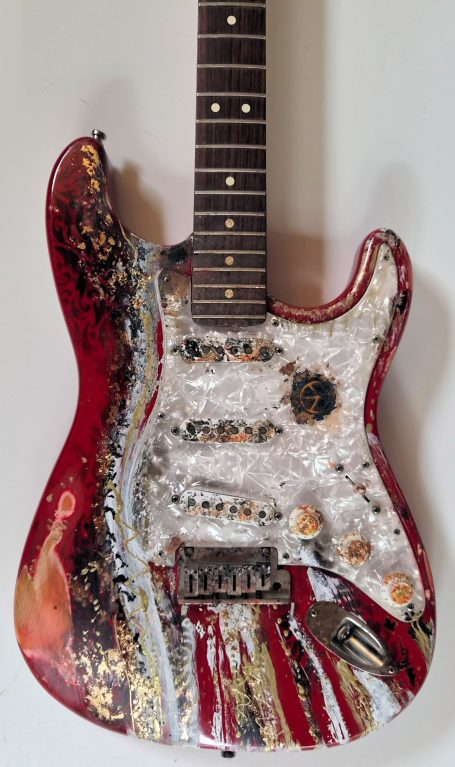
- 28 - “Crimson Resonance” Fender Stratocaster 1994 Anniversary Commissioned Artwork
- 29 - Neon Constellation
- 30 - Vintage 1960 Framus Western QUIET STRENGTH
- 31 - Acoustic – The golden Reign
- 32 - Acoustic – Beyond the Silence
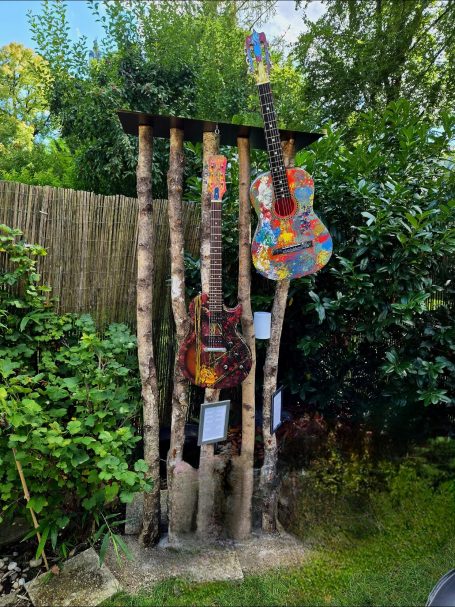
- 33 - Sculptural Work II — THE SANCTUARY OF SOUND
integrierte Werke :
Painted Sound No. 27 – Beneath the Silence
Painted Sound No. 32 – Beyond the Silence
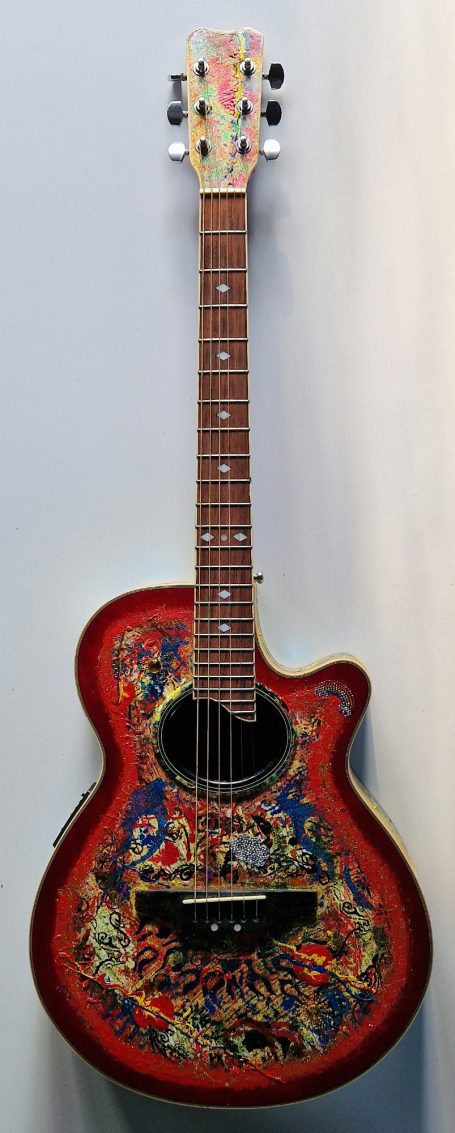
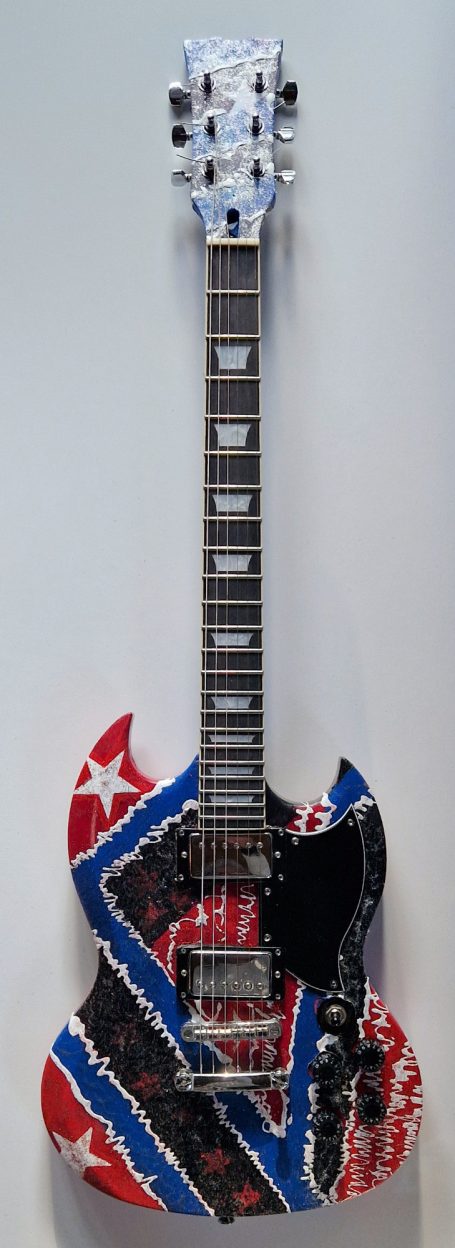
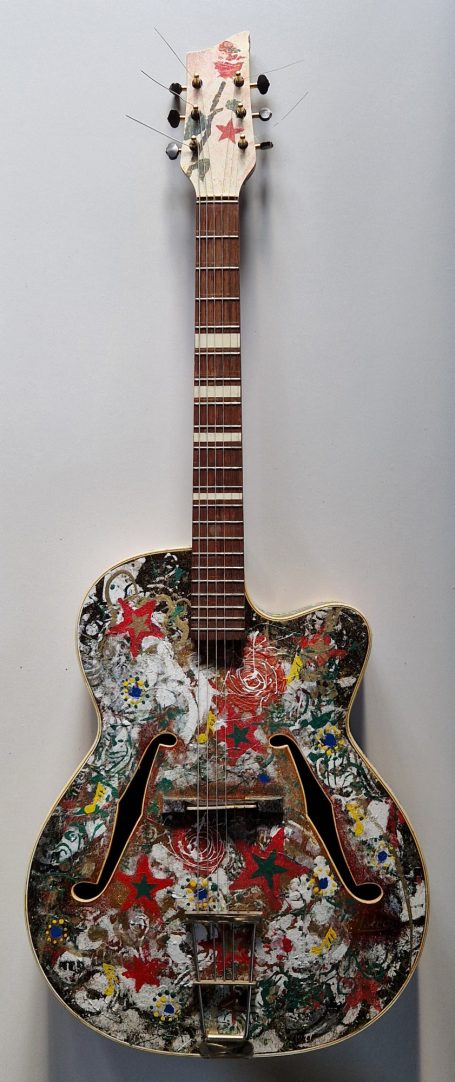
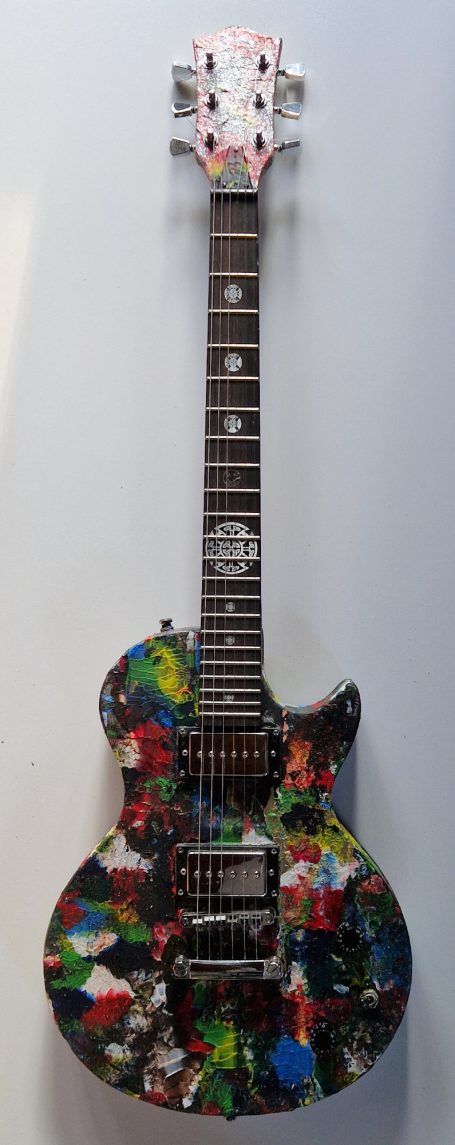
Guitar Nr. 1. Les Paul – The Birth of Chaos
Atmospheric analysis
This Les Paul seems like a mythological beginning. The surface breathes explosion: layers of color overlap, layers emerge as if tones had been laid down as pigments. The mood is ritualistic and archaic—the guitar evokes a first chord from which an entire universe springs forth.
Formal characteristics
Dominance of green, bronze, and blue in dense, overlapping fields. Small figurative motifs (dancers, musical symbols) are integrated but never dominant — they emerge like relics from underground. The composition balances between organic curves and deliberate splashes.
Texture & materiality
Deep interplay of layers: transparent glazes over opaque color bodies create spatial depth. Partially slightly rough surface, areas with metallic sheen (bronze effects) that change in the light and thus simulate “cosmic” depths.
Compositional dynamics
Centripetal in effect: impulses break out from the center, expand, and fragment at the edges. Despite the chaos, a clear flow is discernible—not a purely random image, but a controlled explosion.
Symbolism
Dancers as life force, stars as a reference to the cosmos, musical symbols as a metaphor for the original chord. Together, the guitar becomes the “creation scene” of the series.
Emotional temperature
Mystical, exciting, instinctive — a guitar that creates tension and at the same time has a sacred effect.
Position in the cycle
Birth: Starting point for all subsequent steps, source of energy.
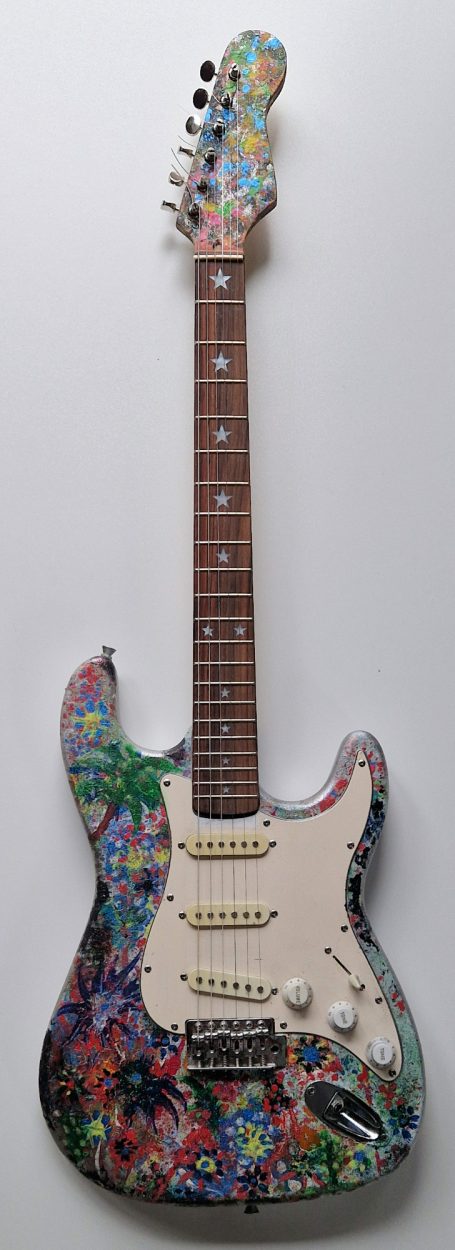
Guitar Nr. 2. Stratocaster – The Dance of Light
Atmospheric analysis
The Stratocaster transforms explosive energy into movement. Its atmosphere is light-flooded, tropical, and dance-like—sound becomes visible here as a flowing, rhythmic gesture.
Formal characteristics
Color spectrum with rich green, pink, and blue; fine glitter elements and floral motifs (palm trees, flowers) set narrative accents. Compositionally, it works with recurring wave and arch shapes.
Texture & Materiality
Finely shimmering layers of lacquer, selective glitter coatings, thin glazes, and locally opaque layers of oil create a dynamic richness of surface; the lacquer sealant enhances the feel and play of light.
Compositional dynamics
Flowing diagonally: the image movement “dances” across the body, rhythmic repetitions structure frequencies like beats.
Symbolism
Palm trees and floral elements signal freedom, travel, summer; the glitter particles are small musical sparks — improvisation as a visual effect.
Emotional temperature
Light, carefree, cheerful—an exuberant celebration of the moment.
Position in the cycle
Translation of primal energy into playful movement—the cycle becomes “danceable.”
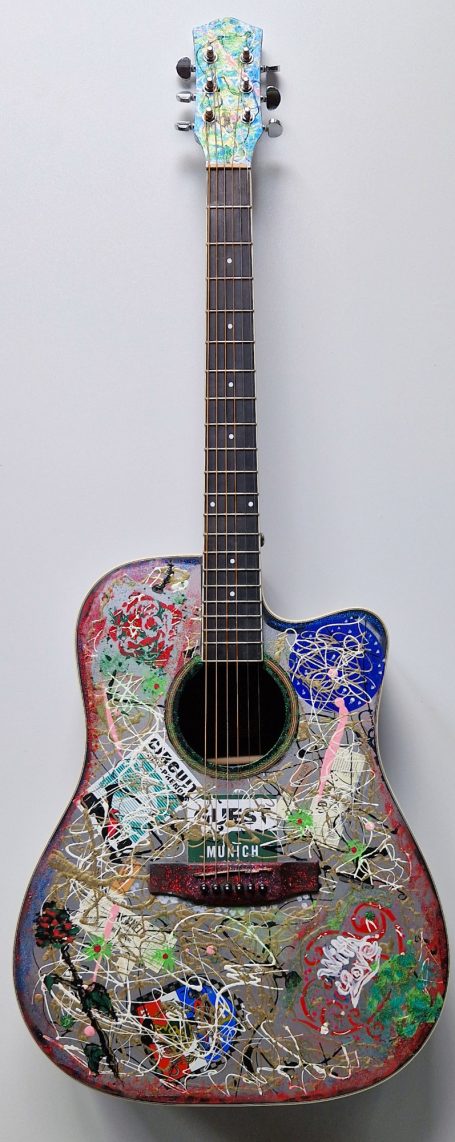
Guitar Nr. 3. Acoustic Guitar – The Memory of Wood
Atmospheric analysis
This acoustic guitar is a raw diary: urban, gestural, unpolished. It radiates the presence of the studio process—it is not the finished picture that is visible here, but its creation.
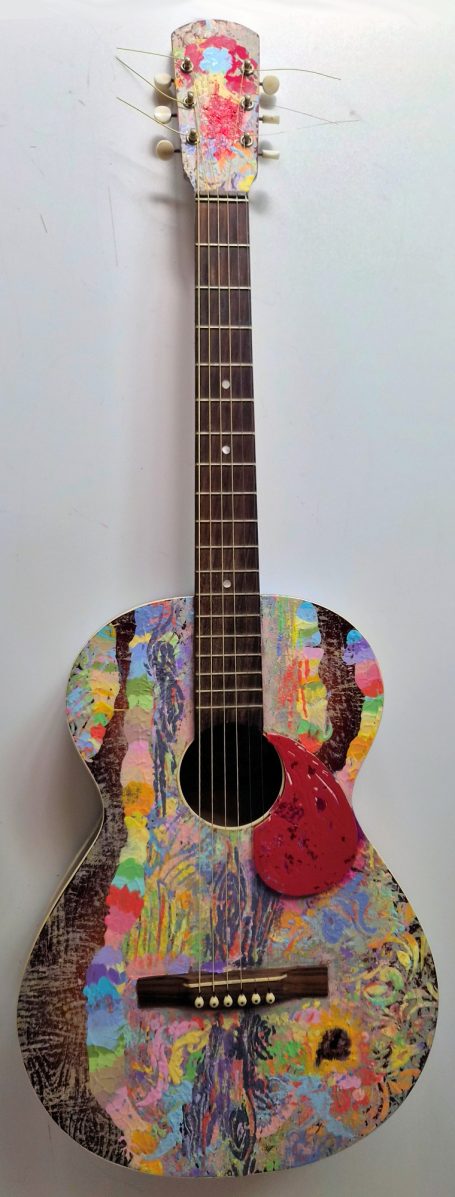
Formal characteristics
Matte earth tones, gestural fragments of writing, sticker impressions (e.g., “Munich,” “Circuit”), spontaneous lines—the composition is fragmentary and dense at the same time.
Texture & materiality
Rough matte finish, visibly filled and painted-over areas; the materiality emphasizes signs of use and process, almost like a wall with painted-over posters.
Compositional dynamics
Vertical and gestural movements dominate, the surface appears to be driven across by layers and overpaintings—the image is in motion, as if it were constantly renewing itself.
Symbolism
Writing as urban memory, stickers as markers of places/relationships; the acoustic guitar becomes a place of lived stories.
Emotional temperature
Restless, raw, personal — authenticity takes precedence over aesthetics.
Position in the cycle
The documentary, “realistic” moment: a counterpoint to mythology, immediate life.
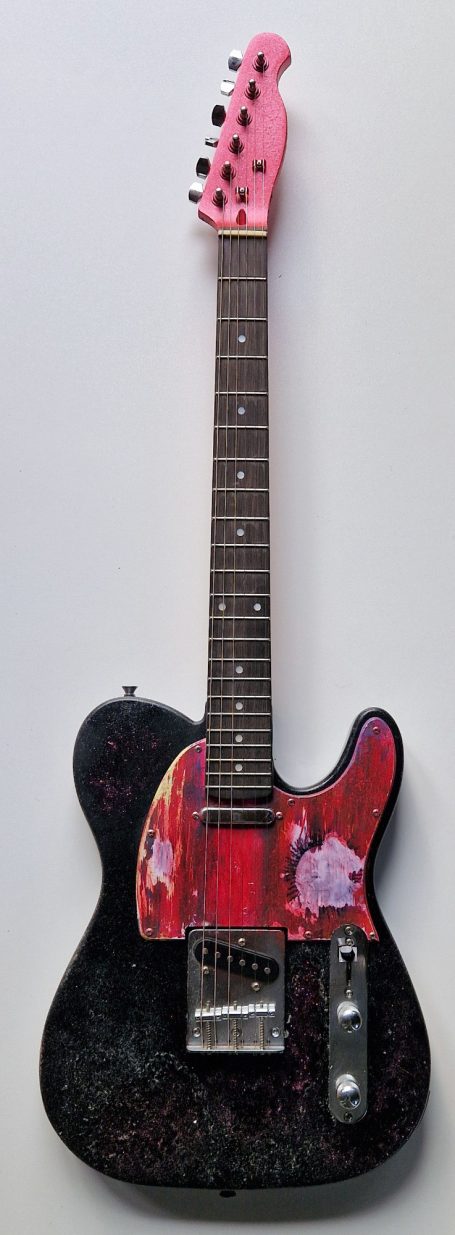
Guitar Nr. 4. Telecaster – The Rust of Time
Atmospheric analysis
The Telecaster conveys patina, age, and dignity. Its presence is archaic and says: use is history, age is dignity.
Formal characteristics
Weathered red and black tones, exposed wood sections, patina effects; the visual language is more closely linked to material aging than to painterly freshness.
Texture & materiality
Scratch marks, weathered areas, matte reductions; deliberately applied abrasions and washes create the impression of historical substance.
Compositional dynamics
Calm, horizontally anchored; less movement, more sedimentation — the composition reads like layers of history.
Symbolism
Rust and scars as signs of time; wood as an honest material, as a reference to origin and craftsmanship.
Emotional temperature
Serious, dignified, melancholic-affirming.
Position in the cycle
Reflection point: the experience of time as a central theme.
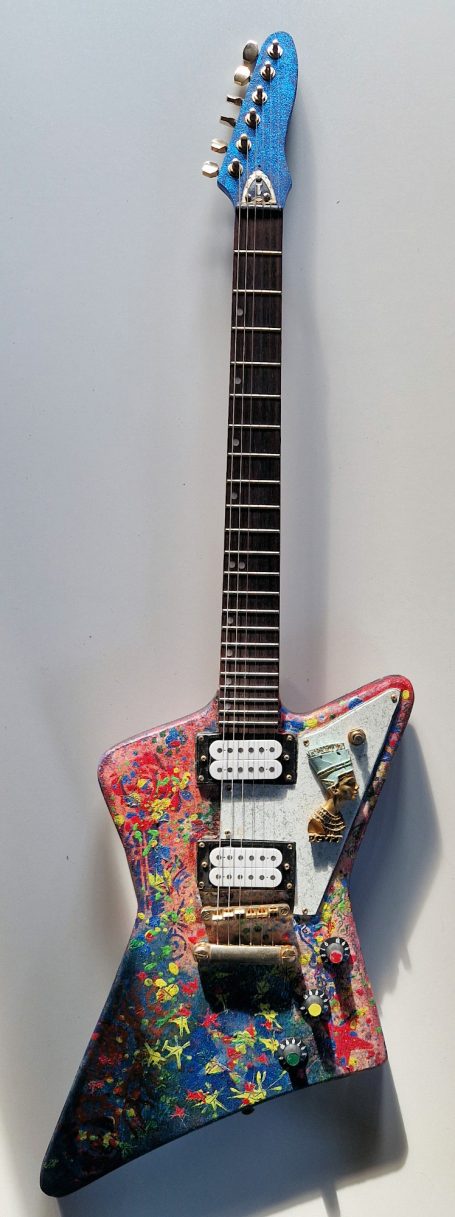
Guitar Nr. 5. Explorer – The Divine Chaos
Atmospheric analysis
The Explorer is opulent, overloaded, and iconic at the same time. It looks like an altar where pop iconography, myth, and psychedelia come together.
Formal characteristics
Strong neon colors, dense ornamentation, a central Egyptian relief (Nefertiti) as a calming influence; the composition is dense and multi-layered.
Texture & materiality
High-gloss surfaces alongside dense layers of color; partial metallic effects, particular gold accents.
Compositional dynamics
Eccentric: explosive centers surround a static center—the movement revolves around myth.
Symbolism
Nefertiti as a sign of temporality and beauty; colors as an ecstatic form of creation.
Emotional temperature
Ecstatic, transcendent, overflowing with meaning.
Position in the cycle
Culmination point: Myth as an aesthetic synthesis of chaos and order.
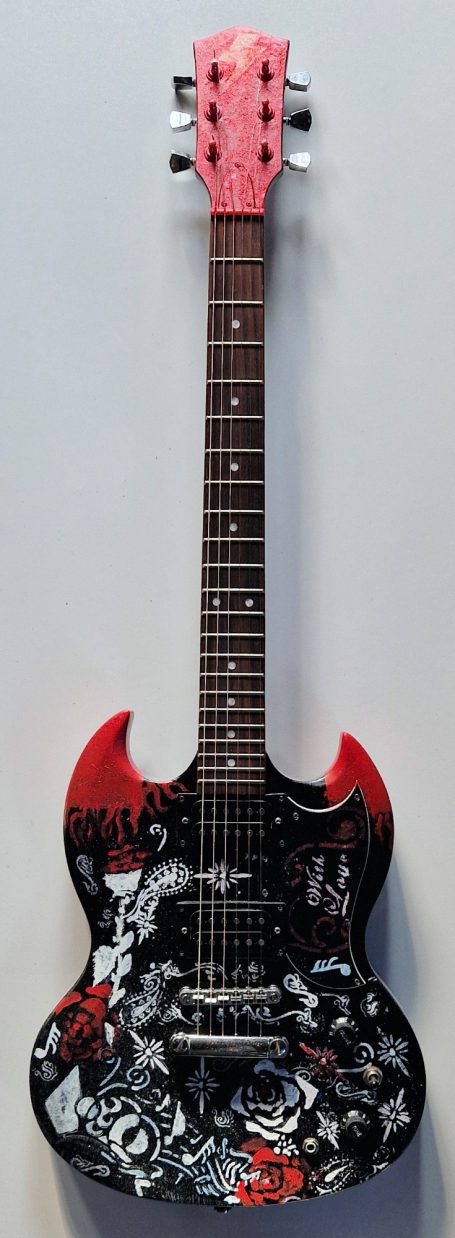
Guitar Nr. 6. SG – The Dark Romance
Atmospheric analysis
The SG is intimate and baroque in style—a dark, romantic meditation. It reads like a letter: personal, familiar, imbued with sadness and passion.
Formal characteristics
Contrasting red-black-white triad, floral ornaments, lettering (“With Love”) — the visual language is rich in ornamentation and narrative.
Texture & materiality
Glossy lacquer surfaces with a fine ornamental engraving illusion; partially glazed to suggest depth behind the lacquer.
Compositional dynamics
Concentric, drawn toward the center; ornamentation creates intimate spaces.
Symbolism
Roses = love/loss; lettering as a direct address; stars as points of remembrance.
Emotional temperature
Melancholic, wistful, poetic.
Position in the cycle
Emotional anchor: intimacy and memory as a counterforce to the explorer's showmanship.
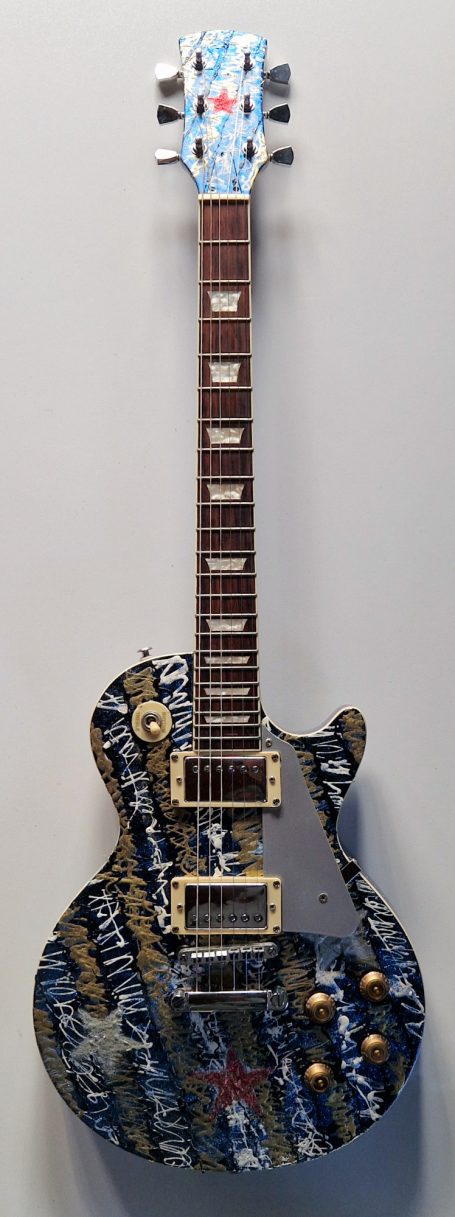
Guitar Nr. 7. Les Paul – The Stardust Frequency
Atmospheric analysis
A younger Les Paul, combining cosmos and contemplation: sonic stardust lying nebulously in the lacquer.
Formal characteristics
Shimmering shades of blue, silver, and purple; finely distributed “star” particles; very controlled color transitions.
Texture & materiality
Glass-like surface, very fine particles that glow when the light changes — the materiality creates an illusion of depth.
Compositional dynamics
Breathing, circulating; little break, instead gentle pulsation.
Symbolism
Stardust = frequency, universe = sound space; the image takes acoustic metaphors literally.
Emotional temperature
Sublime, calm, expansive.
Position in the cycle
Spherical perspective: the series opens up into the distance.
Guitar Nr. 8. Vintage acoustic – The Phoenix Ember
Atmospheric Analysis
This acoustic guitar is a manifesto of regeneration: warmth rises from dark cores, ashes turn to embers.
Formal characteristics
Warm color spectrum (orange, red, gold), flowing layers, spark and ash details.
Texture & materiality
Shimmering, partly sandy layers; the varnish has a “glowing” feel, almost like burnt wood radiating new warmth.
Compositional dynamics
Ascending movement: denser at the bottom, lighter at the top—like flames opening up.
Symbolism
Phoenix = rebirth; embers = memory; gold = healing.
Emotional temperature
Warm-hearted, optimistic, vulnerably strong.
Position in the cycle
Reconstruction: the cycle motif of renewal.
Guitar Nr. 9. SG – The Rebel Pulse
Atmospheric analysis
The second SG is a storm of sparks: raw, urban, immediate. It radiates rebellion—visual punk aesthetics meet orchestral aggression.
Formal characteristics
Powerful palette of red, blue, black, and white; strong diagonals; a striking star as a leitmotif.
Texture & materiality
Glossy planes on matte contrasts; dynamic layers that appear like “electrified” leather.
Compositional dynamics
Sawtooth patterns, diagonal strokes, riff-like rhythms — visual attack as musical counterpart.
Symbolism
The star = direction/compass; diagonal paths = impulse and rupture; color contrasts = conflict and energy.
Emotional temperature
Explosive, combative, breathing with restlessness.
Position in the cycle
Storm before the calm; moment of escalation with transformative energy.
Guitar Nr. 10. Vintage Archtop – The Carnival of Memory
Atmospheric analysis
“The Carnival of Memory” is a visual feast: overlapping memories become colorful sequences that appear both frivolous and bittersweet. The archtop guitar serves as a stage here, its interior (F-holes) windows into a collective experience—variety show, street festival, intimate concert night.
Formal characteristics
Rich red-gold-white spectrum, star-like accents, spirals, and rose motifs. The ornamentation is dense but structured; many small centers compete without dividing the whole.
Texture & materiality
Soft, layered glazes, selective gold particles, partially roughened white application — the surface simulates both patina and festive lighting.
Compositional dynamics
Circular movements dominate; the eye travels in spirals across the body, finding its bearings again in stars, musical notes, and roses. No dominant vanishing point — the guitar is a mosaic of moments.
Symbolism
Carnival = collective memory; stars = stage; roses = intimacy; spirals = temporality. Together they form an archive that encompasses both loud celebrations and private devotions.
Emotional temperature
Warm, nostalgic, celebratory, with a melancholic undertone — a celebration of the past.
Position in the cycle
Reflective conclusion: not an ending, but a summary that brings together breadth, depth, and personal stories and points to an open future.
Guitar Nr. Nr. 11 Les Paul — The Veins of Creation
Atmospheric effect
An eruptive, untamed work of art. An instrument like a newly formed planet: colorful, raw, full of energy and impulsive movement. It seems as if the surface is still warm—a guitar in the heat of creation.
Formal characteristics
The iconic, round body shape remains a stable structure, but the painting radically breaks it up. Splashes, swirls, patches—a chaotic composition that allows no moments of calm. The white crackle structures are reminiscent of earth fissures.
Texture & materiality
Thick layers of paint create a haptic relief that refracts light in different ways. The guitar becomes an object that you want to touch.
The surface looks like volcanic lava, cooled down yet full of inner heat.
Symbolism
Chaos as the origin. Sound as form.
The color energy represents creative explosion, the moment before order emerges. The embedded dark areas are like shadows of uncertainty from which artistic impulses are born.
Emotional temperature
Very high
Impulsive, demanding, uncontrollable. No distance, no filter. It sweeps you away.
Position in the cycle
The first in the second cycle.
It represents the beginning of a new story.
What became a memory in the first cycle is reignited here — as fiery, physical energy.
Guitar Nr. 12 Stratocaster-Silhouette — The Eyes Within the Night
Atmospheric effect
A nocturnal stage set full of mysterious creatures.
A dark background, streaked with glowing symbols—as if eyes were peering out from the depths.
The guitar appears like a portal into a mysterious cosmos.
Formal characteristics
A clear dividing line runs diagonally across the body:
a boundary between two worlds—night blue vs. explosion of color.
The graphic elements (eye shapes, flames, star motifs) provide orientation in the chaos without domesticating it.
Texture & materiality
The surface has a relief-like structure: layers that look like craters, almost like lunar landscapes.
The colors seem to glow beneath the blue — a depth effect that comes to life in the movement of the stage.
Symbolism
Seeing, being seen, vigilance.
The eye motifs represent consciousness—the creative observes itself.
The flames signal urgency: art must burn in order to exist.
The diagonal line separates intuition and control.
An inner struggle—and an alliance.
Emotional temperature
A mixture of darkness and energy
Tension, awakening, nocturnal alertness.
A guitar that asks questions — and hides answers.
Position in the cycle
This guitar is the first consciousness after the creative explosion.
Where No. 11 was chaos, No. 12 is insight:
Art begins to see.
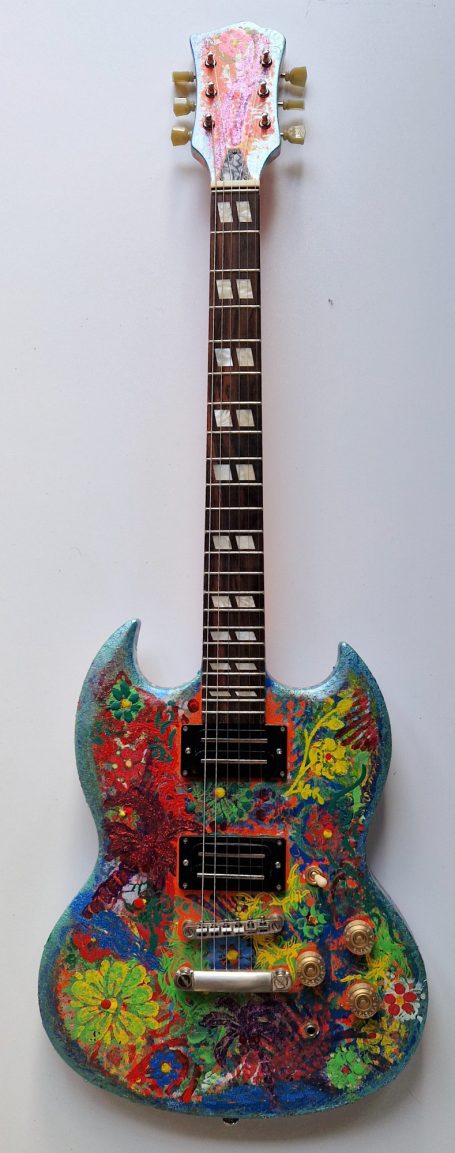
Guitar Nr. 13 SG – The Jungle Whisper
Atmospheric effect
A tropical, lush atmosphere full of life. Rich shades of green, yellow, and red, combined with floral patterns, palm trees, and blossoms, create a jungle-like depth.
The guitar feels like a musical stroll through a vibrant garden—rhythmic, sun-drenched, alive.
Formal characteristics
The SG shape supports the vertical and diagonal movement of the floral motifs.
Leaves and flowers follow the contours of the body, while areas of color flow organically into one another.
Texture & materiality
Multi-layered lacquer creates a relief-like surface; the colors seem to shimmer and pulsate at different angles of light.
Subtle glitter particles enhance the vitality of the composition.
Compositional dynamics
The direction of movement of the floral elements leads the eye from the base of the body to the headstock, with rhythmic lines conveying the impression of musical flow—sound becomes visible, movement becomes color.
Symbolism
Nature, growth, freedom
Palm trees and flowers represent vitality, energy, and creative freedom.
The guitar conveys a sense of organic development, of energy drawn from nature and from within.
Emotional temperature
Vital, joyful, light
Liveliness and optimism, harmonious power, both playful and lush.
Position in the cycle
This guitar is the third instrument of the second cycle (No. 13), a calm but powerful counterpoint between the somber No. 12 (The Eyes Within the Night) and the dramatic No. 14 (Baroque Fire).
It acts as a colorful, lively interlude that brightens the cycle and prepares the transition to opulence.
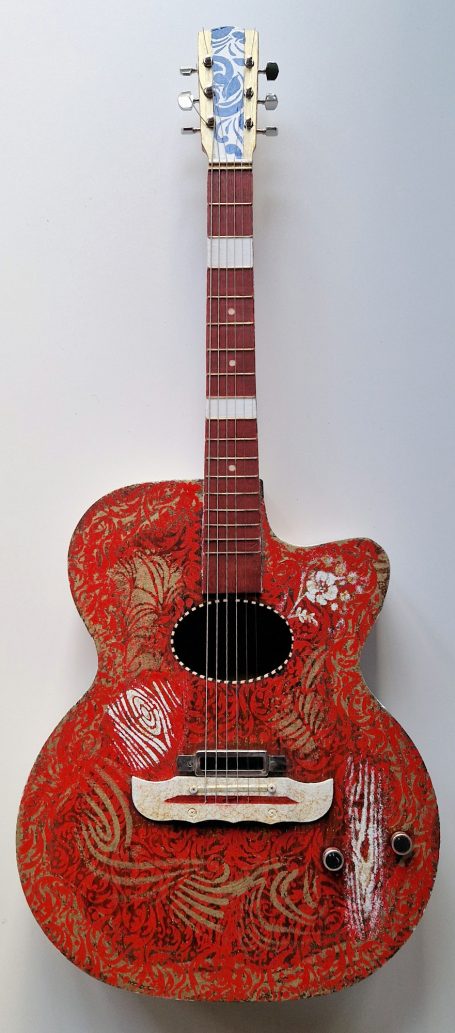
Guitar Nr. 14 vintage Archtop – Barock Fire
Atmospheric effect
A dramatic, almost theatrical stage of light and shadow.
Warm, golden-red tones flare up against a dark background.
The guitar looks like a musical baroque palace going up in flames – opulent, passionate, fiery.
Formal characteristics
The elegant, curved lines of the archtop body emphasize the classic shape, contrasted by expressively placed areas of color.
Harmonious curves meet diagonal, impulsive strokes of color.
Texture & materiality
Relief-like, multi-layered lacquer coats create depth, almost like an oil painting.
Golden highlights shimmer like gold leaf, while red and orange tones intensify the energy of the composition.
Compositional dynamics
The color movement follows an ascending, spiral-shaped dynamic—from the base of the body upward to the headstock.
This spiral conveys ascent, transformation, drama.
Symbolism
Passion, rebirth, baroque opulence
The combination of flame colors and classical ornaments refers to the union of history and creative explosion.
Emotional temperature
A mixture of heat, tension, and solemnity
Passionate, energetic, extroverted—an emotional firestorm.
Position in the cycle
This guitar marks the end of the second section of the cycle (Nos. 11–14) as a dramatic conclusion.
It combines the experience of the previous instruments with baroque opulence and expressive firepower.
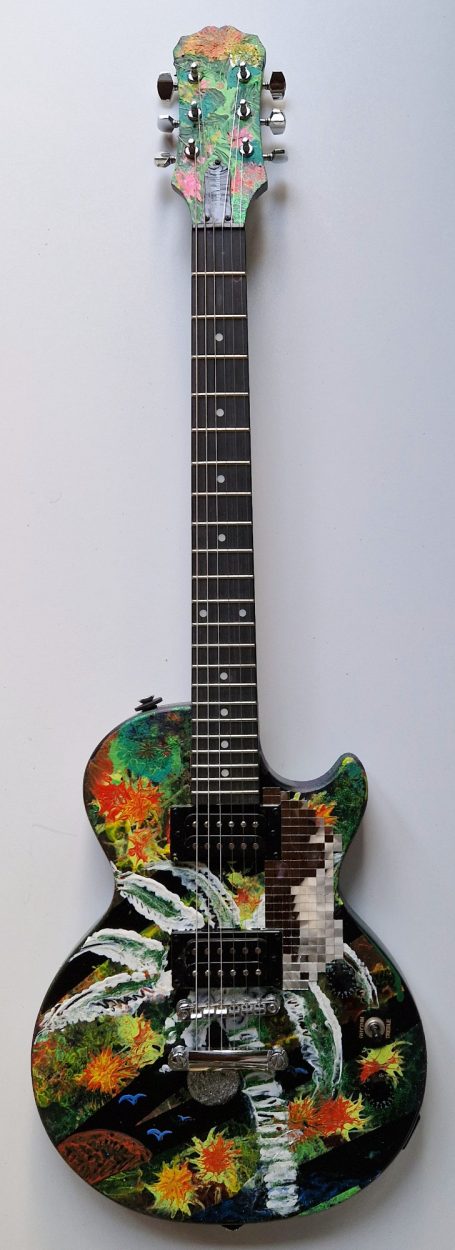
Guitar Nr. 15. Les Paul – Lunar Palm Ascension
Atmospheric effect
A nocturnal vision: a white palm tree against a cosmic firmament, above it a clear, silver moon. The guitar oscillates between calm and energy—a luminous dream state that connects heaven and earth.
Formal characteristics
Central white application of the palm tree, geometric moon circle, colored rays and explosions in yellow, pink, turquoise, and red. A vertical upward movement is interrupted by radial bursts of color.
Texture & materiality
Dense layers, relief-like areas, night glow, cosmically shimmering surfaces. The moon remains smooth and calm – a clear contrast.
Compositional dynamics
Vertical ascent (nature → sky), radial explosion (light → energy).
Together, they create a spiral of ascent.
Symbolism
Nature + Cosmos
Growth + Insight
Grounding + Transcendence
The palm tree represents life, the moon represents consciousness, and the colors represent cosmic expansion.
Emotional Temperature
Cool and warm at the same time—meditative, poetic, ascending.
Position in the Cycle
Final conclusion of Cycle II.
The cosmic state after the baroque fire transformation.
A calm, radiant final light — the moment of insight.
Guitar Nr. 16 - “Stellar Covenant” (Stratocaster-Silhouette – Custom Circle / Zyklus III – Beginning)
Atmospheric effect
This guitar seems like a solemn pact between chaos and order.
In contrast to the eruptive primal works of the first cycle, a mature, balanced energy is palpable here: explosive, but controlled. The surface is reminiscent of a universe that has already experienced many supernovae—traces of heat, light, growth, and memory overlap. It conveys liveliness without aggression, joy without naivety. A guitar that shows presence without having to be loud.
Formal characteristics
The Stratocaster shape serves as the ideal vehicle for the visual language: open, ergonomic, iconic.
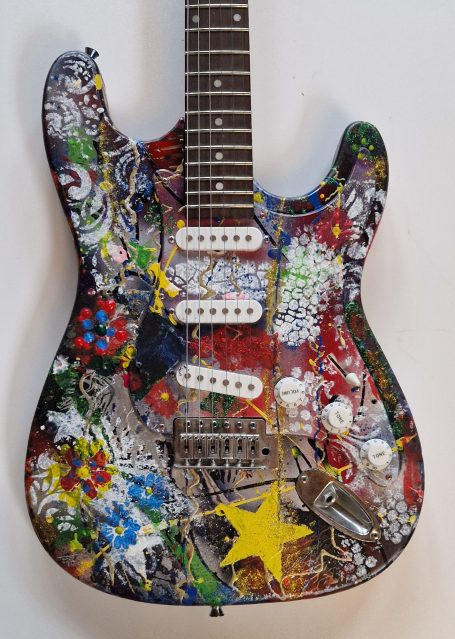
The composition is distributed evenly across the body, without a dominant center — instead, a network of events emerges : floral elements (bottom left), cosmic particles and splashes, a striking yellow star shape as a visual anchor, rhythmic lines that act like musical tracks. The painting respects the form, but does not submit to it — it activates it.
Color & pictorial space
The color space is multi-layered and deliberately not monochrome:
Primary colors (red, yellow, blue) as emotional undertones
White as a connecting, breathing element
Dark passages as depth and contrast
Golden accents as a reference to value, dignity, and permanence
The yellow star serves as a point of orientation: hope, direction, signature.
Texture & Materiality
The surface has a pronounced tactile relief.
Layers, drops, splashes, and impasto zones create a tactile presence—you can feel that this guitar was made, not decorated.
The materiality conveys:
Craftsmanship + Intuition + Time
It is not a smooth luxury object, but an authentic artifact.
Compositional dynamics
The movement is rhythmically distributed — like a song with multiple motifs that repeat, vary, and comment on each other. Not a linear narrative, but a visual improvisation piece.
The lines are reminiscent of musical phrasing: pauses, accents, repetitions.
Symbolism
Star → orientation, hope, personal guiding point, floral elements → growth, life, positivity, splashes & lines → spontaneity, energy, freedom, overlaps → life paths, encounters, decisions.
The overall image is that of a successful, lived life that is aware of its origins but looks ahead.
Emotional temperature
Warm, optimistic, powerful
This guitar is inviting, not challenging.
It celebrates energy without dominating — a quality that is rarely found.
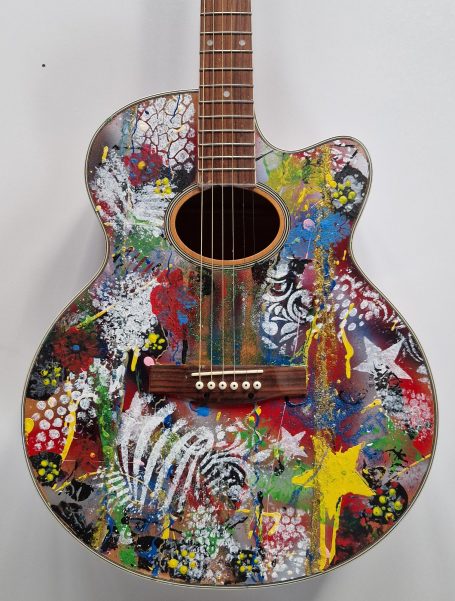
Guitar Nr. 17 - “Golden Resonance” (Acoustic Western – Custom Circle / Zyklus III)
Atmospheric effect
This guitar radiates depth, grounding, and consistency.
Where No. 16 embodies connection and new beginnings, No. 17 resonates with resonance and anchoring. It is less extroverted, but all the more enduring. The atmosphere is reminiscent of a place where music is not performed, but lived. It is a guitar with inner calm, yet full of movement—not loud, but carrying.
Formal characteristics
The Western shape offers a generous, open surface that is fully activated by the painting.
The central sound hole area functions as a resting heart around which the visual action unfolds.
The composition works with:
asymmetrical balance,
organic color clusters,
targeted accents (star motif, floral structures),
flowing lines that act like sound waves.
Everything remains open, breathing, not condensed.
Color & image space
The color space is more earthy and harmonious than in No. 16:
warm brown and red tones,
rich green tones as a reference to life and nature,
white as a structuring element,
gold as a calm, valuable accent color.
The yellow star reappears, but less dominantly—not as an exclamation, but as a confirmation.
Texture & Materiality
The surface displays a multi-layered, almost geological texture.
Spatula-like sections, dripping lines, and glazed transitions create depth without heaviness. The materiality appears handcrafted, honest, tangible: this guitar does not seek to shine—it seeks to sound.
Especially on an acoustic guitar, the painting seems like an extension of the sound box, not like a skin over it.
Compositional dynamics
The dynamics are circular and resonant.
Movements are not linear, but wave-like—comparable to sound spreading through space.
The eye does not follow any hard directions, but drifts—just like acoustic music that does not impose itself, but accompanies.
Symbolism
Star → Orientation without urgency
Floral motifs → Growth, continuity, care
Overlaps → Cooperation, partnership, shared path
Gold accents → Value through substance, not volume
This guitar speaks of a shared history and common foundation.
Emotional temperature
Warm, calm, stable
It conveys trust. No drama, no struggle — just presence and reliability.
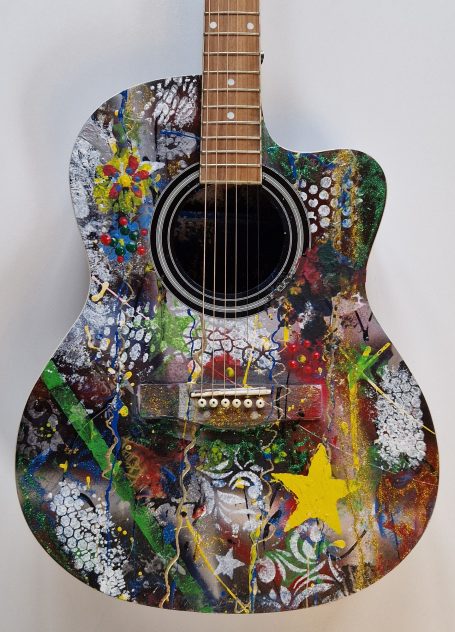
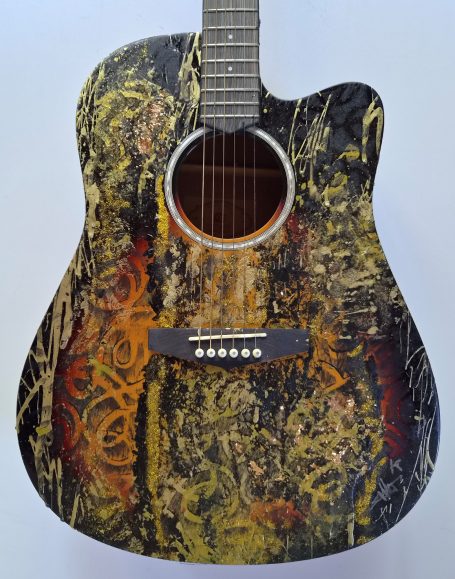
Guitar Nr. 18 - “Origin / Painted Core” (Acoustic Cutaway – Custom Circle / Zyklus III)
Atmospheric effect
This guitar is neither a mediator nor a counterpart—it is the center. It is No. 18 Origin and Responsibility. The atmosphere is intense, dense, and at the same time open. You can sense that nothing here was made “for someone”—but rather out of inner compulsion. This is not a gesture. It is a position.
Formal characteristics
The cutaway shape appears to be a deliberate opening: not decorative, but functional – almost biographical. The sound hole area is less a haven of peace than a maelstrom. The painting draws in from all sides, as if everything that was and is converges there. The composition is complex, multi-layered, asymmetrical, deliberately superimposed. That is precisely what makes it credible.
Color & pictorial space
No. 18 is the most color-dense of the three guitars. Strong contrasts (red/blue/yellow), massive white settings, recurring star motifs, floral structures, black marks and lines like traces or markings. The yellow star appears here not as an accent, but as a statement. It is not friendly – it is present.
Texture & materiality
The surface is raw, multi-layered, sometimes almost aggressive.
You can see: overpainting, corrections, deliberate imperfections, drops, splashes, pressure marks.
This is crucial: this guitar wants to hide nothing. It bears the process, the doubt, the decision—visibly.
Compositional dynamics
The movement is radial and fragmented.
There is no gentle flow as in No. 17, no directed impulse as in No. 16. Instead:
Simultaneity. Past, present, and possibility lie on top of each other.
The eye jumps—just like thoughts in creative phases.
Symbolism
Stars → self-location, not desire
Floral elements → growth despite chaos
Black shapes → breaks, boundaries, reality
Gold accents → value that has been earned
This guitar speaks not of success, but of attitude.
Emotional temperature
Intense, honest, uncompromising
This is not a “beautiful” guitar in the classical sense.
It is a true one.
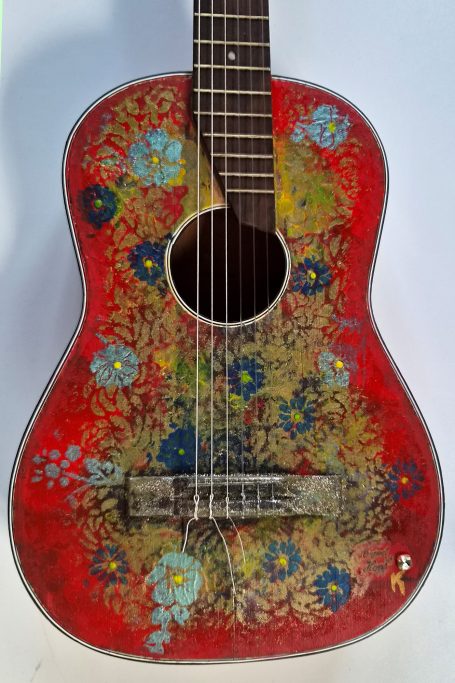
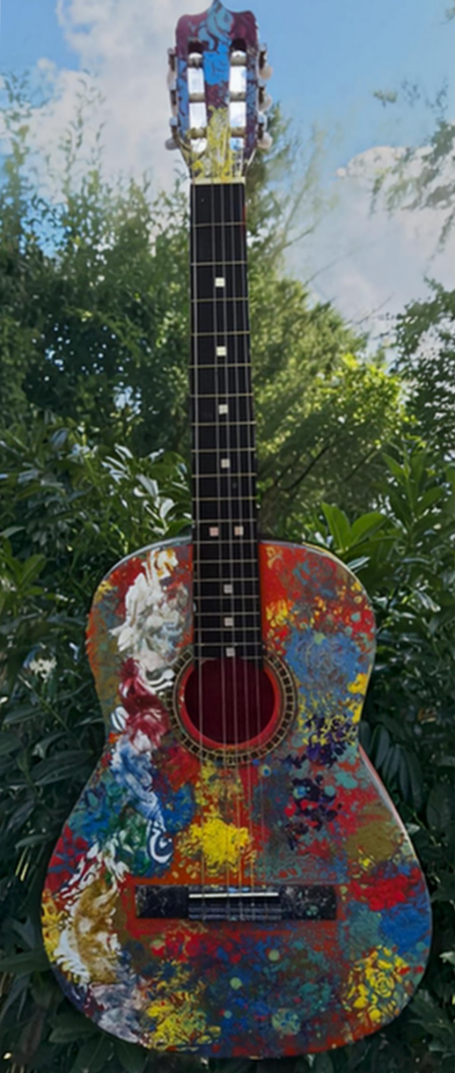
Guitar No. 19 – “Dorli” (Hopf Travel Guitar, ca. 1950s–1960s)
Atmospheric Effect
This guitar carries a palpable sense of time within it. Unlike the previous works, it does not feel explosive or cosmic, but rather grounded, almost narratively serene.
The floral patterns exude an almost nostalgic aura—like an echo of past journeys, songs, and touches. The guitar appears like a found object that has not been recreated, but rather retold.
Formal Characteristics
The classic, minimalist form of the Wandergitarre remains clearly recognizable.
The painting respectfully follows this structure and does not overlay it, but rather integrates itself into the existing geometry.
The floral elements are evenly distributed and form a cohesive pictorial field that is less fragmented than in earlier works.
Color & Pictorial Space
A warm, deep red dominates, enveloping the entire body of the work.
Overlaid upon this are golden structures that resemble ornamental nets.
Shades of blue, green, and yellow provide floral accents that appear like small, tranquil points of sound.
The pictorial space is not open or explosive, but rather dense and closed, with an almost textile-like effect.
Texture & Materiality
The surface appears softer and less relief-like than in earlier works.
Golden layers create a slightly shimmering patina reminiscent of aged fabrics or historical surfaces.
The materiality represents time and sedimentation rather than energy.
Compositional Dynamics
The composition is stable and expansive.
No strong diagonals or explosive movements—instead, a calm, almost ornamental spread across the entire surface.
The eye moves smoothly, without breaks or axes of tension.
Symbolism
Memory, Origin, Time
The floral patterns represent nature and continuity.
The gold refers to value—not as luxury, but as refined remembrance.
The guitar becomes a vessel of history, not of explosion.
Emotional Temperature
Warm, calm, introverted
A work without urgency.
It demands nothing—it remains.
Position in the Overall Cycle
This guitar stands outside the classical dramaturgy of Cycles I and II.
It belongs in:
Cycle III – Expansion / Archive / Level of Memory
It is not a departure, but a look back.
A quiet counterpoint to the energy of the entire work.
Objekt Nr. 20 – Sculptural Work I - The Keeper of Sound
Atmospheric Effect
This object marks a fundamental break—and at the same time, an opening.
Here, the guitar is no longer merely a medium for painting, but part of a physical gesture.
The arms transform the instrument into a figure.
The work feels like a moment of intimacy:
protection, an embrace, a merging.
Formal Characteristics
Vertical orientation, clear axis.
The guitar forms the core; the arms break through the pure logic of the object and create an anthropomorphic silhouette. The connection between the instrument and the body fragment creates a new form—somewhere between sculpture and object art.
Color & Visual Space
The color treatment remains in the style of Painted Sound:
multilayered, expressive color fields, floral elements, gestural lines.
However, the three-dimensional expansion creates a real space—color is no longer just a surface, but envelops volume.
Texture & Materiality
The combination of wood, varnish, plastic (arms), and metal creates a hybrid materiality.
The surface remains painterly, while the form already speaks sculpturally.
The work moves between:
Object – Body – Sign
Compositional Dynamics
Centered and vertically aligned.
The arms create a closed movement—a circular shape that envelops the guitar.
This gesture introduces emotional physicality into the work for the first time.
Symbolism
Relationship, protection, identity
The guitar is no longer played—it is held.
The work speaks to:
• The connection between people and music
• Possession vs. relationship
• Art as something one not only views, but embraces
Emotional temperature
Warm, intimate, direct
The most personal work to date.
Not cosmic, not abstract—but human.
Position within the body of work
This is a turning point. Not Cycle I. Not Cycle II. Not just Custom Circle.
This is: the beginning of a new group of works:
Painted Sound – Sculptural Works. This object is: the first step into the space, the transition from painting to sculpture, the beginning of a new collector’s category
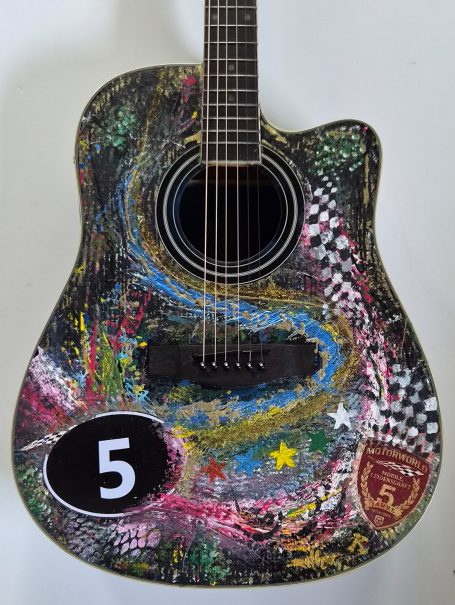
Guitar No. 21 “THE 24h RESILIENCE” One-of-a-Kind Art Guitar Edition : 5 Years of Motorworld Munich
Curatorial Context
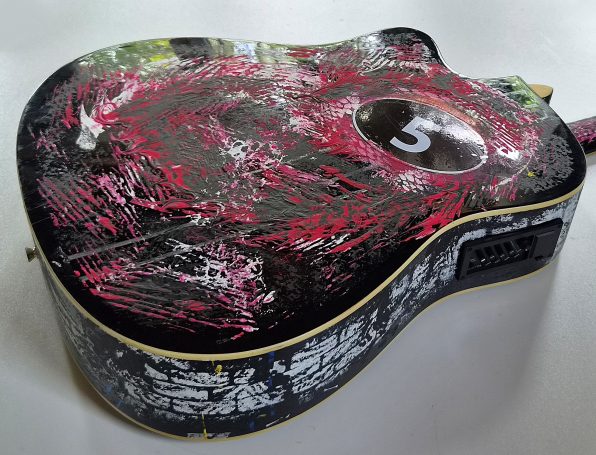
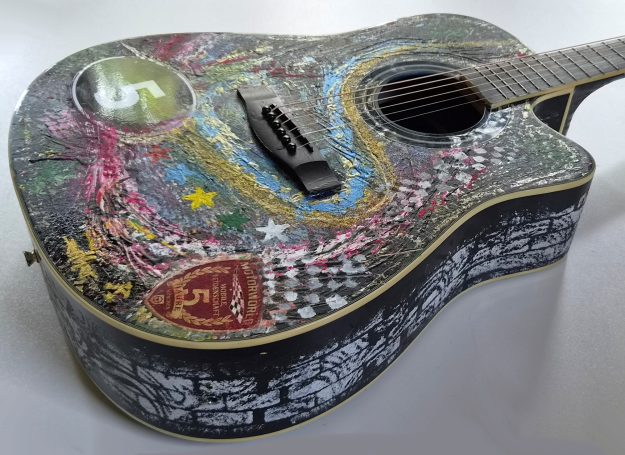
This work is a symbiosis of kinetic energy and sonic aesthetics. Created to mark the fifth anniversary of Motorworld Munich, the instrument captures the raw dynamism of motorsports and the elegance of handcrafted mechanics. The Aesthetics of the Road: The heavily textured surface (impasto) evokes the texture of asphalt, rubber grime, and the patina of historic race cars. The design deliberately breaks with the perfection of industrial paint finishes and celebrates the imperfection and power of the handmade. Symbolism: The striking “5” and the official Motorworld emblem anchor the piece in the historical context of the venue. “Gold and magenta create a tension between festive presentation and raw energy.” Functional art: Despite its expressive design, the object remains a precise musical instrument. The contrast between the wild outer shell and the technical purity of the sound makes this guitar a unique collector’s item. “This instrument is not just meant to be looked at—it carries the rhythm of the engines in its strings.”
Atmospheric Effect
“THE 24h RESILIENCE” evokes an atmosphere of perpetual motion. The work appears as a visual condensation of speed, night racing, trails of light, and mechanical tension. Despite the immense energy, it does not result in chaotic destruction, but rather in a controlled form of resilience. The guitar conveys the feeling that it is still in the midst of movement—between asphalt, sound, and adrenaline. The front possesses an open, almost cosmic dynamism, while the back appears significantly darker and more emotionally condensed. This creates a tension between public performance and inner intensity.
Formal Characteristics
The composition is based on a spiral-like main movement organized around the soundhole and bridge. The instrument’s form is not concealed but deliberately utilized to create axes of movement. Particularly strong is the interplay of: • linear impulsive movements • condensed fields of material • open areas of calm • relief-like structures Despite its high complexity, the guitar remains legible. The gestural painting is held together by recurring paths and directions. Formally, the neck functions as a vertical axis of rest between the energetic pictorial spaces of the front and back.
Color & Pictorial Space
The pictorial space is created primarily through superimposition. Black does not serve as a background here, but rather creates a sense of spatial depth from which fields of color and movements emerge. Gold, cyan-blue, and magenta in particular generate axes of light within the surface. The color spaces do not appear flat, but rather atmospheric: like reflections of light on oil, metal, or wet asphalt. The white grid and stencil structures generate additional visual frequencies and are reminiscent of: • checkered flags • race markings • abrasion-like traces • technical diagrams This creates a hybrid pictorial space between urban abstraction and racing aesthetics.
Texture & Materiality
The work’s strong materiality is one of its most important characteristics. The surface possesses an almost topographical quality: scratches, compacted areas, glitter varnishes, impasto layers, and transparent overlays create a physical depth that would be nearly impossible to reproduce digitally. The work thrives on the interplay between: • rough asphalt textures • glistening refractions of light • spontaneous gestural interventions • controlled compositional fields In places, the materiality evokes weathered race car bodies or historic workshop surfaces. It is precisely this that creates authenticity.
Compositional Dynamics
The central movement runs in a spiral pattern across the entire front. The “5” functions not only as a symbol but as the visual starting point of the energy movement. From there, a system of counter-movements, flows, and condensations unfolds. Crucially: The composition never tilts completely toward the center but remains in constant motion. The back, on the other hand, works more with compression and pressure. It feels like the energetic back of an engine: more compact, hotter, more immediate. This creates an almost musical alternation between the front and back: Front → Expansion … Back → Compression
Symbolism
The symbolism is deliberately left open-ended, without becoming arbitrary. The “5” marks the specific occasion: 5 years of Motorworld Munich. At the same time, it becomes a universal symbol for: • Race number • Identity • Speed • Recognition • Endurance The title “THE 24h RESILIENCE” expands this layer of meaning. Here, resilience does not stand for calm, but for resilience under sustained intensity: 24 hours of movement. 24 hours of pressure. 24 hours of energy. The guitar thus connects motorsports and music through a shared principle: Rhythm under tension.
Emotional Temperature
The work possesses a high emotional temperature. It comes across as loud, fast, and physical—yet at the same time, not aggressively destructive. Instead, it creates a form of emotional charge reminiscent of live music, race nights, and urban energy. Gold particles and glitter finishes prevent the work from becoming too heavy or too dark. They create brief moments of light within the density. This keeps the work lively rather than oppressive.
Guitar No. 22 — “ASHES OF CONTROL”
Atmospheric Effect
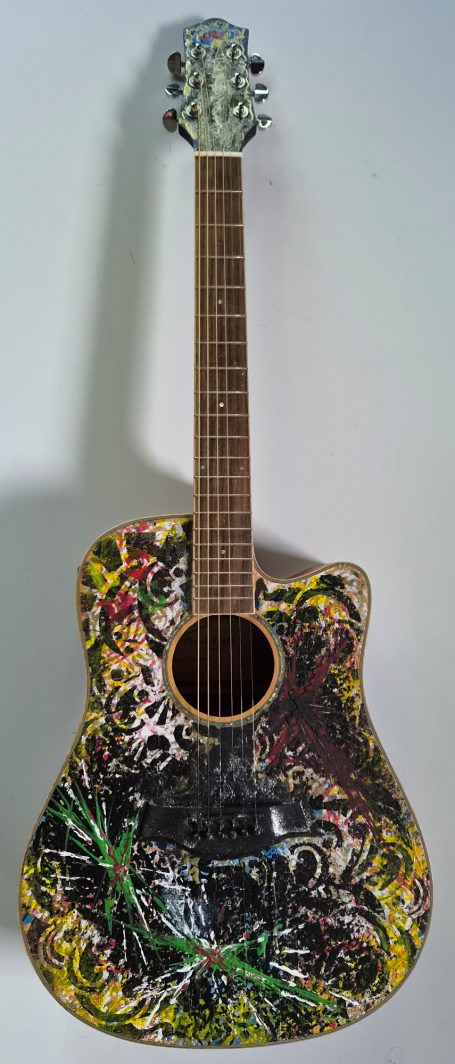
The work creates an intense emotional tension between explosion and exhaustion. The surface appears as a visible emotional state of emergency—raw, fragmented, and at the same time poetically condensed. Despite the aggressive gestures, a surprising intimacy emerges.
Formal Characteristics
The composition combines free, expressive painting with rhythmic calligraphic structures. Recurring fragments of symbols and radial star shapes provide orientation within the apparent chaos. The front and back function as two emotional states of the same work.
Color & pictorial space
Black forms the dominant resonant space from which neon colors—magenta, yellow, and green—erupt. The front appears electric and unstable, while the back develops an almost meditative heaviness through deep red-violet.
Texture & Materiality
The heavily layered surface creates a physical presence. Color concentrations, overlays, and visible movements in the application of paint are reminiscent of urban walls, burnt posters, or damaged stage sets. The work deliberately thrives on imperfection and traces of the process.
Compositional Dynamics
The diagonal movements and explosive centers create a constant tension. At the same time, the black gestural lines hold the work together and prevent the complete disintegration of the pictorial order.
Symbolism
The star and impact shapes represent emotional collisions, but also moments of hope within inner darkness. Here, the instrument becomes less an object of musical harmony and more a vessel for personal memory and psychic energy.
Emotional Temperature
Highly emotional, intense, and vulnerable.
The work oscillates between anger, fatigue, defiance, and the attempt to capture beauty despite inner exhaustion.
Position within the overall cycle
“ASHES OF CONTROL” marks a distinctly more personal and existential phase within the Painted Sound cycle. While earlier works focused more on dynamics, pop culture, or performative energy, this piece opens up a direct autobiographical resonance for the first time. It is precisely this that gives it an extraordinary authenticity.
Guitar No. 23 – Les Paul “After the Applause"
Work Type
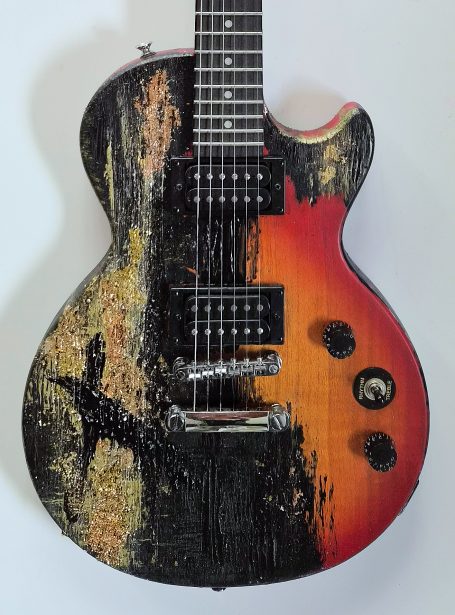
Hand-painted playable Les Paul interpretation, mixed media on electric guitar, one-of-a-kind / playable art object
Curatorial Statement
“AFTER THE APPLAUSE” does not focus on the moment of performance—but rather on the emotional space that follows. The work captures the lingering echoes of energy, success, exhaustion, and memory.
Between a scorched surface, fragmented luxury aesthetics, and the remnants of a classic Sunburst icon, a work emerges about resonance, loss, and dignity.
The guitar appears as an object that has already lived: loud, intense, visible—and now bears only its traces.
The instrument’s original identity is deliberately preserved in part. It is precisely this contrast between classic rock ’n’ roll aesthetics and radical reduction that generates the work’s emotional tension.
Artistic Analysis
Front — Deconstruction of the Icon
The front is based on a classic Les Paul silhouette—a symbol of musical power, virtuosity, and cultural significance.
This iconic form is not destroyed, but partially stripped away.
The raw black surface resembles:
- burnt wood,
- asphalt,
- oil,
- soot,
- layers of memory.
- The gold does not appear decorative, but rather like:
- fading light,
- embers,
- remaining dignity,
- past glory.
- The partially preserved original sunburst finish creates a second temporal layer:
- The instrument visibly reveals its former identity.
- This creates a rare tension between:
- past and present,
- glamour and exhaustion,
- stage and silence.
Back — Resonance Chamber
The back evokes a significantly calmer and emotionally deeper visual language.
Black, dark red, and golden reflections bring to mind :
- cities at night,
- light reflections on wet asphalt,
- distant skyline structures,
- urban solitude.
The surface has a cinematic quality.
In contrast to the energetic front, this side does not make a statement but rather creates an atmosphere.
It is precisely this restraint that makes the back the emotional center of the work.
Materiality & Surface
The surface is deliberately left raw and imperfect.
Traces,
scratches,
layers,
abrasions, and open textures are not concealed but made visible as part of the emotional narrative.
As a result, the work clearly moves away from decorative instrument design and approaches contemporary object art.
Curatorial Context
Within the PAINTED SOUND cycle, “AFTER THE APPLAUSE” marks a stronger shift toward emotional reduction and atmospheric depth.
The work moves between:
- Contemporary Art,
- musical memento,
- emotional material aesthetics
- and urban object culture.
The focus is not on the instrument’s perfection, but on its resonance as a vessel of lived experience.
Central themes
- Resonance after the performance
- Memory and loss of identity
- The beauty of fragmentation
- Dignity despite exhaustion
- Deconstruction of musical icons
- Urbanity and emotional isolation
- The echo of success and energy
Artistic Features
Asymmetry as a Source of Tension
The deliberate partial treatment of the front creates a dynamic visual instability.
Atmospheric Back
The back conveys a greater emotional depth than the front, extending the work beyond the realm of classical guitar art.
Playability as Part of the Concept
The piece remains fully playable, thereby preserving its original function as a soundbox.
Technical Basis
Base Instrument : Les Paul-Style Electric Guitar
Technique: Mixed Media / Hand Painting / Layering / Finish
Finish: Deliberately Raw and Atmospheric
Work Status: One-of-a-Kind / Signed Piece
Position within the cycle
While earlier works in the PAINTED SOUND cycle focused more on energy, symbolism, and expressive imagery, “AFTER THE APPLAUSE” develops a significantly more restrained and emotionally intense visual language.
The work ranks among the most atmospheric and curatorially mature pieces in the series.
Guitar No. 24 “Velvet Frequencies” Electro-Acoustic 60s Jazz Guitar
Italy, ca. 1965–1975, Restored & transformed by Klaus Kother
Atmospheric Analysis
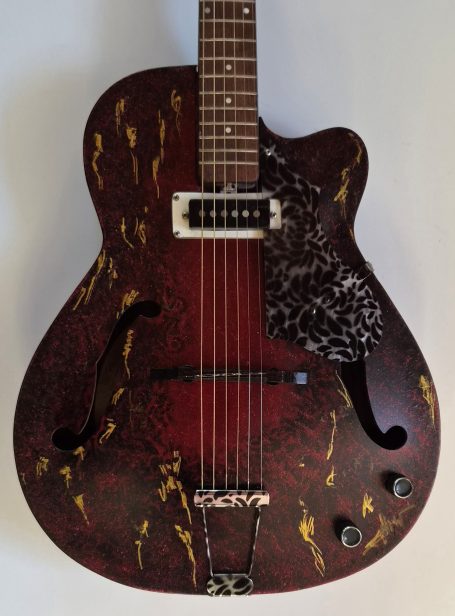
Velvet Frequencies feels like a floating resonance chamber suspended between a jazz club, memory, and nocturnal elegance.
The work does not radiate an open explosion, but rather a slow, vibrating intensity.
The instrument no longer seems to produce sound, but rather to have stored it—like a final note lingering in the room.
The atmosphere is dark, velvety, sensual, and at the same time permeated by a subtle inner tension.
Formal Characteristics
Deep black, wine-red transitions, and fragmented gold accents form a controlled, luxurious color architecture.
The ornamental patterns appear like baroque shadows or organic frequency fields.
The semi-transparent pickguard creates a deliberate contrast between elegance and wildness.
The composition works less with explosion than with condensation and subtle movement.
Texture & Materiality
The surface possesses an extraordinary material depth.
Sparkle finishes overlay matte and silky areas, creating a pulsating play of light.
The effect changes depending on the viewing angle:
at times it appears soft as velvet, at others electric, almost glowing.
The gold lines do not appear artificial, but rather like spontaneous, energetic cracks within the surface.
Compositional Dynamics
The work unfolds its movement not through sharp contrasts, but through slow currents.
The ornamental forms circle almost imperceptibly around the center, creating a suspended tension.
The reverse side further enhances this effect:
less event, more reverberation.
As a result, the entire guitar functions like a visual echo.
Symbolism
The wine-red center represents inner fervor, memory, and residual emotional energy.
The black border zones appear as absorbing silence or darkness following the sound.
The gold fragments appear as:
- remnants of light,
- fragile flashes of memory,
- or traces of lingering beauty in decay.
- The pickguard introduces a second layer:
- glamour, the stage, excess, and rock ’n’ roll instinct.
Emotional Temperature
Darkly glowing, melancholic, elegant, and highly atmospheric.
The work carries no aggressive energy, but rather a controlled intensity—like a voice after midnight or music from an abandoned club.
Position in the Cycle
Within *Painted Sound*, *Velvet Frequencies* marks a transition from expressive explosion to atmospheric densification.
The work no longer represents a new beginning or chaos, but rather resonance, memory, and maturity.
It is among the quieter, yet emotionally deepest works of the cycle to date.
Curatorial Analysis
With the Melody Archtop Mod. 225, Painted Sound reaches a new phase of artistic condensation.
The work moves away from the immediate explosion of earlier pieces and instead shifts toward atmosphere, memory, and controlled resonance.
The original Italian archtop guitar—an instrument bearing visible traces of time and structural vulnerability—was not merely restored, but transformed into a state where the act of repair itself becomes part of the aesthetic.
The work is based on a classic sunburst design:
a deep black at the edges, a wine-red center that emerges from the darkness like glowing residual heat.
Yet unlike traditional vintage instruments, the surface does not remain nostalgic.
It is overlaid with:
- ornamental shadow structures,
- vibrating layers of sparkle,
- fragmented gold lines,
- and an almost organic movement of depth within the lacquered surface.
As a result, the guitar appears less like an object —
and more like an acoustic reverberation, materialized on wood.
Front — Resonance After the Climax
The front exhibits an extraordinary balance between control and disintegration.
The center glows like residual stage energy after the end of a concert.
The black peripheral zones do not appear harshly defined, but rather absorbing—like darkness that slowly swallows sound.
The ornamental patterns do not appear decorative, but rather evoke:
- trails of smoke,
- charred velvet textures,
- baroque shadows,
- or electric resonance fields.
- Only upon closer inspection do the gold lines reveal themselves.
- They do not function as ornamentation,
- but rather as:
- fragile reflections of light,
- cracks in the darkness,
- brief bursts of energy,
- or traces of lingering memory.
Their placement is crucial:
They do not dominate the surface,
but only interrupt it sporadically.
This creates tension.
The instrument begins to shimmer.
The Pickguard as a Counterpoint
The semi-transparent pickguard is particularly striking.
Its leopard-like, psychedelic-looking pattern creates a deliberate contrast to the body’s melancholic undertone.
This gives rise to a rare duality:
- Elegance and wildness,
- Memory and the stage,
- Control and excess.
The pickguard seems almost like a relic of glam rock, Art Deco, and psychedelic aesthetics all at once.
It brings movement to the instrument’s quiet depths.
Back — The True Emotional Plane
As with several works within the cycle, the back develops an unexpectedly strong emotional impact.
It is quieter.
More abstract.
More open.
The large wine-red surface appears almost incorporeal—like a fading core of light.
The dark ornamental fields do not frame this core symmetrically,
but rather like slow currents.
It is precisely the extreme reduction of the gold traces that makes the back so powerful.
It does not appear designed in the classical sense,
but rather atmospheric.
Almost like:
- a final note in the room,
- an empty concert hall,
- or the memory of something
that has already passed.
The reverse side no longer speaks of performance—
but of reverberation.
Sides and Neck — Transition Zones
The sides play a central role in the work.
They not only connect the front and back,
but also function like cinematic transitions between two emotional states.
The scattered gold fragments along the dark edges are reminiscent of:
§ electrical wires,
§ reflections of light in the shadows,
§ or traces of slow energy movement.
The neck subtly continues this language.
The ornamental lines there appear almost like charred plant forms or old tattoos beneath varnish.
This creates a complete visual circular movement across the entire instrument.
Restoration as Part of the Statement
An essential aspect of this work lies in the visible process of transformation.
The guitar was:
- opened,
- repaired,
- re-glued,
- structurally stabilized,
- electronically tested,
- and subsequently artistically reinterpreted.
As a result, the instrument’s history is not hidden—
it becomes part of the work.
Not perfection,
but rebirth is at the center.
Art-historical classification
The work moves between:
- Art Deco,
- Glam Rock,
- Dark Romanticism,
- Informal Art,
- Psychedelic Surface Art,
- and sculptural object art.
Within the Painted Sound cycle, Melody marks a transition:
away from the pure explosion of energy in earlier works —
toward more subtle emotional spaces.
The guitar does not scream.
It glows.
Curatorial Conclusion
After the Applause is among the most atmospherically dense works of the cycle to date.
The work does not unfold its effect immediately,
but layer by layer.
It thrives on:
- intimacy,
- shifts in light,
- depth of material,
- and the tension between elegance and transience.
The guitar seems like an instrument
that no longer needs to be played
to produce sound.
It has itself become resonance.
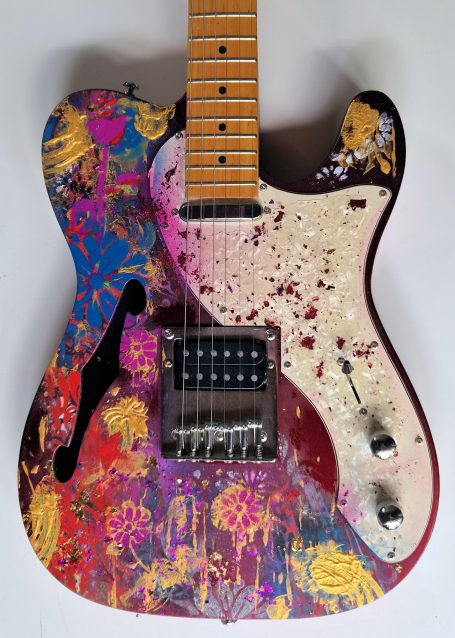
Guitar No. 25 Tele Style Thinline “Voodoo Summer” 2026
Curatorial Analysis
Atmospheric Analysis
Voodoo Summer feels like the memory of a summer that is long gone yet still lingers in the skin.
The work oscillates between festival, road trip, flower power, the vastness of America, and personal longing.
Unlike many psychedelic works, it is not nostalgic.
It feels lived.
The flowers do not appear decorative, but rather like traces of a summer lived.
Color fields, gold particles, and glittery surfaces create an atmosphere somewhere between concert lights, a dusty road, and a sunset.
The guitar feels like an object that has stored stories.
Formal Characteristics
The composition is based on three main axes:
1. Candy Apple Red Base
The original paint remains visible.
This is crucial.
It serves as a visual anchor and connects the front and back.
2. Psychedelic color zone
Violet, pink, blue, and red overlap on the left side of the body.
This is where the work’s true energy emerges.
The colors appear spontaneous, yet remain controlled.
3. Gold as a rhythmic element
Gold does not appear as a luxurious material.
It resembles sunlight.
Like dust.
Like fading memories.
The distribution remains irregular and prevents any decorative overload.
Texture & Materiality
One of the work’s most striking characteristics.
Various surface layers come together:
- Gold leaf
- Glitter lacquer
- Acrylic paint
- Stencils
- Spray paint
- Original finish
This creates an almost archaeological surface.
One gets the feeling of seeing multiple layers of time superimposed upon one another.
Compositional Dynamics
The front develops a diagonal movement from the top left to the bottom right.
The floral forms do not serve as ornaments.
They function like musical accents.
Almost like individual notes within an improvised guitar solo.
The white pickguard area creates an important counterpoint.
Without this large, light surface, the work would collapse.
The Back
The back is perhaps the biggest surprise.
It does the exact opposite of the front.
Instead of an explosion:
Simplicity.
Instead of abundance:
Emptiness.
Instead of a festival:
Memory.
The single pink flower stem becomes the central motif.
Almost like the last remaining flower after a long summer.
The few gold particles look like stars or fading points of light.
This creates a poetic calm that lends the front a second layer of meaning.
Symbolism
Flowers
Transience.
Joy of life.
Summer.
Freedom.
Gold
Sunlight.
Memory.
Value.
Loss.
Pink and Violet
Emotion.
Longing.
Music.
Improvisation.
Candy Apple Red
Passion.
American guitar culture.
Rock ‘n’ Roll.
The single flower on the back
Perhaps the strongest symbol of the entire work.
It seems to ask:
What remains when summer is over?
Emotional Temperature
Warm.
Lively.
Longing.
Not aggressive.
Not rebellious.
Not tragic.
The work possesses a surprising lightness.
Position in the PAINTED SOUND Cycle
Among your 25 works to date, Voodoo Summer occupies a special place.
Works such as:
- After The Applause
- Velvet Frequencies
deal more with memory, reflection, and depth.
Other guitar pieces focus on energy and contrast.
Voodoo Summer, on the other hand, is the first work that consistently explores the joy of life.
It feels like an interlude.
A brief respite between the heavier works.
Artistic Context
The timing of its creation is particularly interesting.
The work was created during a period marked by:
- financial uncertainty
- legal pressure
- professional stress
- emotional disappointment
And yet, the result is not a dark work.
That is precisely what makes it relevant.
Voodoo Summer is not an expression of despair.
Rather, it is an expression of resistance against despair.
The guitar asserts color where life currently offers little color.
Curatorial Conclusion
Voodoo Summer is among the most emotionally accessible works in the PAINTED SOUND cycle.
It combines the raw materiality of artisanal craftsmanship with an unusual lightness born of color, memory, and musical freedom.
The work does not tell of a specific summer.
It tells of the wish that a summer might never end.
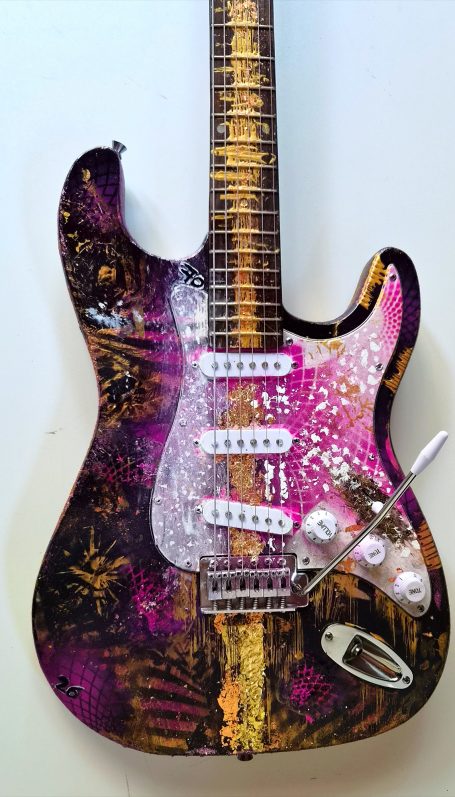
Guitar No. 26 Purple Haze – Echo of Freedom
Mixed Media on Stratocaster
Atmosphere
The work oscillates between psychedelic energy and quiet reminiscence. Vivid shades of magenta, violet, and gold create a vibrant visual world that evokes light, music, and freedom without coming across as nostalgic. The surface seems to glow and yet appear aged—as if it had stored decades of musical history.
Formal Characteristics
The vertical gold axis connects the neck and body into a continuous flow. The light-colored pickguard provides a visual anchor within the dense, painterly structure. The gold, pink, and dark violet areas create a balanced tension.
Materiality
Original Stratocasters with hand-painted finishes. Multi-layered coats of paint, gold leaf, transparent glazes, and intentionally preserved signs of wear blend together to create a vibrant materiality. The finish protects the instrument and lends it additional depth.
Symbolism
Gold represents the enduring value of music.
Pink and violet embody creativity, emotion, and freedom.
The vertical gold streak evokes a stream of sound coursing through the entire instrument.
The work interprets freedom not as a political statement, but as an inner state.
Emotional Temperature
Warm.
Poetic.
Luminous.
Contemplative.
Not aggressive, but open and inviting.
Position within the PAINTED SOUND cycle
Guardian of Resonance marks a turning point. For the first time, PAINTED SOUND moves beyond pure object art and evolves into a large-scale installation. This expands the cycle of works from painted instruments to a comprehensive artistic universe comprising objects, sculpture, space, and light. The installation thus constitutes the first independent group of works within PAINTED SOUND.
Curatorial Conclusion
Guardian of Resonance is not a presentation of a guitar, but an independent work of art. The installation shifts the focus from the instrument to its cultural and emotional resonance. It demonstrates that music continues to exist even in silence—as resonance in space, in memory, and within the viewer. In this way, PAINTED SOUND expands its concept of art from the painted instrument to an immersive artistic experience.
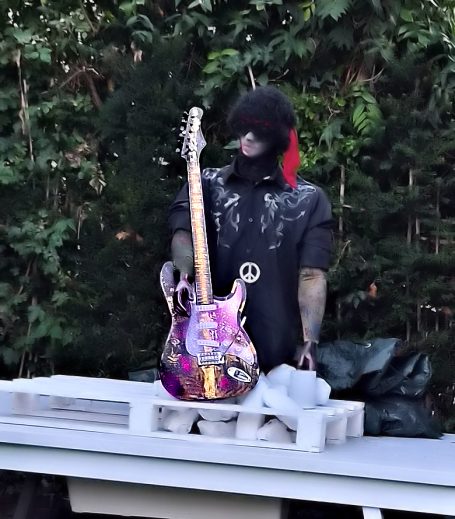
Installation I
The Guardian of Freedom
Mixed Media Installation with Painted Sound No. 26
Atmosphere
The installation has a quiet, almost sacred presence. It resembles neither a stage nor a monument in the classical sense. Rather, it creates a place of remembrance where music lives on as spiritual energy.
Formal Characteristics
The standing figure forms the vertical axis of the installation. The guitar serves as the visual focal point. A white pallet, stones, and a peace symbol create a bright contrast to the dark figure, establishing a balance between light and shadow.
Materiality
A mannequin, a painted guitar, a wooden pallet, white stones, a peace symbol, an LED candle, and found objects come together to form a sculptural unity. The different materials remain deliberately visible and do not conceal their origins.
Symbolism
The figure isn’t playing the guitar—it’s preserving it.
The guitar becomes a reminder of the sound.
The palette represents transformation and creative work.
The white stones convey purity, tranquility, and permanence.
The candle symbolizes the never-ending echo of music.
The peace sign connects music with humanity and hope.
Emotional Tone
Quiet.
Contemplative.
Melancholic.
Dignified.
Meditative.
Position within the PAINTED SOUND cycle
Guardian of Resonance marks a turning point. For the first time, PAINTED SOUND moves beyond pure object art and evolves into a large-scale installation. The cycle thus expands from painted instruments to a comprehensive artistic universe comprising objects, sculpture, space, and light.
Curatorial Conclusion
Guardian of Resonance is not a presentation of a guitar, but an independent work of art. The installation shifts the focus from the instrument to its cultural and emotional resonance. It demonstrates that music continues to exist even in silence—as resonance in space, in memory, and within the viewer.
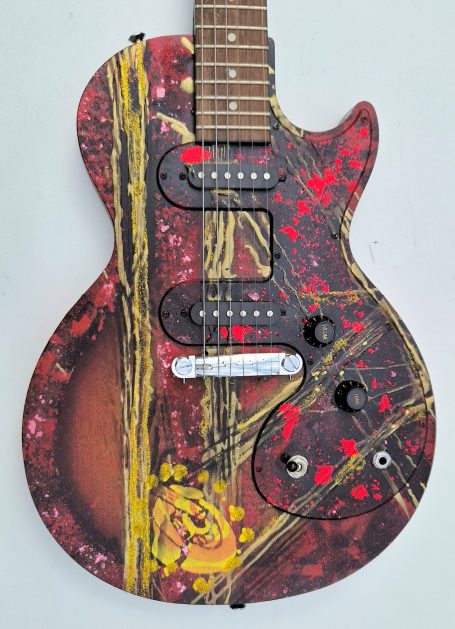
Guitar No. 27 Beneath the Silence
Medium: Hand-painted Epiphone Les Paul, Mixed Media
Curatorial Analysis
With *Beneath the Silence*, the *Painted Sound* cycle achieves a new form of tranquility. While earlier works are characterized by movement, explosion, and overt energy, this piece operates with restraint. Its power lies not in the obvious, but in the hidden.
The body appears like a geological stratification. Dark, nearly black surfaces are intersected by vertical golden lines that appear like tectonic faults or veins of light. In between, fields of color open up in shades of purple, burgundy, ochre, and scattered fragments of bright red. These red accents do not appear decorative, but rather like memories of past intensity—small eruptions within a controlled surface.
Particularly distinctive is the deliberate use of exposed wood and irregular textures. They lend the instrument a material honesty. Nothing appears smooth or artificially perfected. Every trace tells the story of the creative process and reveals that beauty here arises from transformation.
The pickguard integrates completely into the composition. It does not divide the picture plane but becomes part of the painterly rhythm itself. This creates an unusual unity between the instrument and the work of art.
The reverse side consistently carries this concept forward. Horizontal dark bands alternate with organic streaks of color. The few circular structures are reminiscent of a tree’s growth rings or traces of a bygone era. The reverse side is therefore not a secondary surface, but a chapter in its own right within the same narrative.
Within the Painted Sound cycle, *Beneath the Silence* occupies a special place. It is not a loud work. It invites the viewer to step closer. Only up close do the fine gold lines, the transparent layers of paint, the imperfections in the surface, and the subtle transitions between control and chance reveal themselves.
It is precisely this restraint that gives the work its extraordinary presence. The work proves that intensity does not depend on volume. A state of concentrated tension emerges—as if an energy were continuing to live beneath the silent surface, one that never completely disappears.
Atmosphere
“Beneath the Silence” has a contemplative presence. The work does not convey a loud energy, but rather a deep inner tension. Darkness and light are not in contrast, but form a harmonious dialogue. It creates the feeling that an unbroken force continues to work beneath a calm surface.
Formal Characteristics
The composition thrives on the interplay between open wooden surfaces, deep black areas, and delicate gold veins. Vertical lines lend the work stability and unite the top, body, and back into a single design unit. The asymmetrical distribution of the elements creates balance without appearing static.
Materiality
Wood, gold leaf, acrylic paint, pigments, and intentionally exposed original surfaces remain visible. The different materials do not blend completely with one another but retain their individuality. It is precisely this visible materiality that lends the work authenticity and preserves the immediate character of its artisanal creation.
Symbolism
The front evokes geological strata, fissures in the earth, and stored energy. Gold represents light, hope, and permanence. The red fragments seem like memories of past intensity or of embers still smoldering beneath the surface. Exposed patches of wood symbolize time, change, and the dignity of material that has lived.
The reverse side opens up a second narrative layer. Here, the association of a silent universe emerges. Dark bands evoke the space between galaxies; gold dots represent stars and particles of light; circular structures suggest planets or distant galaxies. The reverse side expands the work from an earthly landscape into a cosmic resonance chamber.
Emotional Temperature
Still.
Deep.
Thoughtful.
Dignified.
Timeless.
Contemplative.
Curatorial Context
*Beneath the Silence* demonstrates the growing maturity of PAINTED SOUND’s visual language. The work deliberately eschews spectacular effects and derives its impact from depth, materiality, and compositional tranquility. The front and back tell different chapters of the same story, together forming a cohesive artistic whole and illustrating the transition from expressive gesture to a concentrated, reflective visual language.
Position within the PAINTED SOUND Cycle
*Beneath the Silence* marks an important developmental step within the cycle. The work combines the expressive energy of earlier pieces with a significantly more reduced, controlled visual language. For the first time, the quiet power of the material comes to the fore just as strongly as the painterly intervention. This makes No. 27 one of the most contemplative and, at the same time, most mature works in the entire *PAINTED SOUND* cycle.
Guitar N° 28 “Crimson Resonance”
Fender Stratocaster 1994 Anniversary Commissioned Artwork
Curatorial Analysis
With *Crimson Resonance*, the *PAINTED-SOUND* cycle expands its visual language to include an extraordinary fusion of artistic freedom and personal commission. Although the work was created on commission, it unmistakably bears the cycle’s signature: it is not a decorated guitar, but a standalone work of art.
The composition is dominated by an intense red that spreads across the entire body like a field of energy. Veins of gold leaf, white streams, and dark, deep zones create the impression of constant movement. The areas of color appear like light breaking through matter, while the gilded lines guide the eye through the entire work.
The pearl-white pickguard does not contrast with the painting but rather serves as a serene resonating space. The deliberately aged pickup covers, pot knobs, and metal elements bridge the past and the present. Technology and art merge into a shared visual language.
Particularly noteworthy is the balance between controlled composition and free expression. Nothing seems random, even though the instrument fully retains its spontaneity. It is precisely this tension that gives the guitar its extraordinary presence.
The painted headstock consistently extends the visual language, uniting the neck and body into a single artistic unit. The result is a cohesive work whose impact extends far beyond the classical form of a musical instrument.
The back deliberately provides a counterpoint. The calm, deep-red finish allows the front to take center stage, while the aged pickguard continues the instrument’s story. This minimalist approach lends the piece elegance and prevents any sense of clutter.
Atmosphere
Lively. Powerful. Elegant. Bathed in light. Optimistic. Timeless.
The work conveys the impression of energy that continuously unfolds without becoming aggressive. It radiates warmth, movement, and confidence.
Formal Characteristics
The composition thrives on the tension between bold red surfaces, flowing white structures, and veins of gold leaf. Asymmetry creates dynamism, while the lines connect the entire body of the instrument. The front, headstock, and hardware form a unified design.
Materiality
Acrylic paint, gold leaf, pigments, and intentionally aged hardware meet the classic Fender design. Different surfaces—glossy, textured, and metallic—create an extraordinary sense of depth. The visible materiality remains an integral part of the artistic statement.
Symbolism
Red represents life, passion, and creative energy.
Gold symbolizes light, value, and permanence.
The white streams evoke sound waves, beams of light, or flowing energy.
The aged metal elements bridge the past and the present, telling a story of memory, experience, and time.
The serene reverse side symbolizes the power that need not be visible to exist.
Emotional Temperature
Warm. Intense. Hopeful. Energetic. Dignified. Inspiring.
Curatorial Context
Crimson Resonance demonstrates that a commissioned work can possess the same artistic autonomy as any independent piece from the PAINTED-SOUND cycle. It combines individual client requests with a consistently refined visual language and documents the growing maturity of the body of work as a whole. The combination of expressive painting, high-quality materials, and harmonious composition makes this work a significant example of the artist’s current creative phase.
Position within the PAINTED-SOUND cycle
Guitar No. 28 marks the transition from the contemplative stillness of No. 27—Beneath the Silence—to a new phase of light, movement, and resonance. While No. 27 speaks of stillness and inner depth, “Crimson Resonance” reopens the cycle to energy, optimism, and visible dynamism. As the first documented commissioned work in the catalog, it also marks an important milestone in the development of PAINTED SOUND—the moment when the artist’s signature style is fully preserved even in commissioned works.
Guitar Nr. 29. Strat – Neon Constellation
Atmosphere
An electrifying, urban, yet organic atmosphere. The work appears rich in color, vibrant, and almost pulsating. Between the explosive colors on the left, the white calm zone in the center, and the metallic silver accents, a tension arises between energy and concentration.
Formal Characteristics
The front panel thrives on a deliberate contrast: on the left, neon colors, layers of paint, traces, and green flakes coalesce into a dynamic zone of color; the white center provides a visual resting point. The silver particles around the headphone jack create a small, precise counterpoint. The violet-blue neck and the back panel, which has been treated quite differently, extend the design beyond the front view alone.
Materiality
Acrylic paints, neon pigments, splashes of paint, the finest dots of color, flakes, metallic elements, wood, and chrome combine to form a multi-layered surface. The materiality remains visible and deliberately alludes to the creative process. Nothing appears completely smoothed out or neutralized.
The Seven Stages of Development
The creation of #29 unfolds in seven clearly distinguishable stages of development:
1. Overpainting → 2. Reaction → 3. Transformation → 4. Layering → 5. Reduction → 6. Intensification → 7. Decision
In this way, the development itself becomes an integral part of the work. The final form does not arise from a composition predetermined from the outset, but from an ongoing dialogue between what already exists and the subsequent interventions.
Symbolism
Within the *Painted Sound* cycle, #29 should be understood as a work of transformation. The work documents a transition: from earlier, darker, and heavier visual worlds to a more open, more colorful, and more life-affirming visual language. Here, transformation does not mean the eradication of what came before, but rather its further development.
Emotional Temperature
Electric, restless, energetic, yet at the same time hopeful and open. The work possesses a palpable inner tension. Its color palette does not appear decorative, but rather like an expression of unleashed energy.
Curatorial Context
NEON CONSTELLATION is one of those works in which the creative process itself becomes part of the artistic statement. The seven stages of development reveal that Painted Sound is not based on a single creative act, but rather on layering, reaction, correction, condensation, and conscious decision-making.
Position within the Painted Sound Cycle
Painted Sound #29 is a transformative work within the cycle. It marks a shift in direction within the artist’s development: away from an increasingly dark, heavy visual language toward a more open, color-intensive, and energetic form of expression. Thus, #29 is not merely another stage in the cycle’s development, but a visible turning point.
Guitar Nr. 30. Vintage Framus Western – QUIET STRENGTH
Atmosphere
No. 30 is a work of tranquility, pause, and inner reflection. Its atmosphere arises not from a reduction of color, but from the gentle layering of colors. Pastel tones, traces of color, and dense violet areas create a quiet, almost floating surface.
In contrast to many of the more expressive works in the Painted Sound cycle, No. 30 does not feel like an outburst, but rather like a state following the outburst: the energy is still present, but it has settled into stillness.
Formal Characteristics
The classic silhouette of the historic Framus touring guitar remains fully recognizable. The painterly design follows the shape of the instrument without completely obscuring its original identity.
The composition thrives on the contrast between:
- light pastel areas,
- colored, relief-like layers of paint,
- the deliberately placed darker concentrations,
- the bold red pickguard,
- and the partially preserved areas of the original Darkburst finish.
The fine colored lines within the darker areas create a second level of perception: from a distance, they appear as dark concentrations; up close, these zones come to life again.
Materiality
Materiality is an essential component of the work. Color is not merely used as a surface, but as an applied, developed, and layered substance.
Pastel colors, relief textures, visible brush and tool marks, and the small metallic flakes on the red pickguard create a surface that lies somewhere between a painting, an object, and a historical instrument.
It is particularly important that the Framus’s original materiality has not been completely erased. The preserved Darkburst finish and the instrument’s historical substance remain present as traces of time.
Symbolism
No. 30 represents peace amid turmoil.
The guitar still bears the traces of energy, color, and movement. At the same time, these forces are tempered by the pastel tones and the dark areas crisscrossed with fine lines of color.
The historic instrument itself becomes a vessel of time: an instrument from 1960 is neither restored nor merely decorated, but is given a new life without completely losing its past.
The red pickguard serves as a deliberate counterpoint. It represents the energy and vitality that still remain within an otherwise much calmer color palette.
Emotional Temperature
Quiet. Warm. Thoughtful. Conciliatory.
The emotional temperature of No. 30 is significantly lower than that of many previous works. It is not a melancholic work in the classical sense. Rather, its tranquility possesses a certain defiance:
Here, tranquility is not a state of weakness, but a form of strength.
Precisely for this reason, the work functions particularly well as a personal statement. The surface does not depict a problem-free state, but rather the possibility of maintaining an inner space of tranquility amid difficult times.
Curatorial Context
Within the *Painted Sound* cycle, No. 30 is a work of inner transformation through tranquility.
While other works in the cycle may be more strongly characterized by explosion, confrontation, movement, or emotional intensity, No. 30 shifts the artistic language into a quieter realm.
The work demonstrates that transformation does not always have to arise through intensification. It can just as easily emerge through superimposition, attenuation, preservation, and reorganization.
The historic Framus thus becomes part of the statement itself: an instrument from 1960 enters a contemporary artistic context, connecting the past, the personal present, and new meaning.
Position within the Painted Sound Cycle
Guitar No. 30 marks a deliberate moment of pause within the Painted Sound Cycle.
As the 30th work, it also holds special significance: It represents not only the ongoing development of the series but also a moment in which the artistic language is deliberately scaled back.
No. 30 is thus not a conclusion, but a pause within the development.
The work continues the narrative of the previous pieces but contrasts it with a different emotional tone. Where intensity and expansion may have previously dominated, here a space emerges for memory, stillness, and peace.
It is precisely this that gives No. 30 an important function within the cycle:
It shows that Painted Sound can not only make the energy of life visible, but also the calm necessary to survive that energy.
Artistic Core Statement
Guitar No. 30 stands for peace and inner calm during a time of great personal strain.
The historic 1960 Framus guitar thus becomes the vessel for a contemporary painterly transformation. Its pastel colors, dark concentrations, and delicate lines of color combine vulnerability and strength, while the bold red of the pickguard forms a concentrated counterpoint.
The past remains visible. Color becomes memory. Calm becomes resilience.
The Painted Sound
“The Painted Sound” is not a cycle about guitars.
It is a work about resonance.
About the traces that music, memory, time and emotion leave behind within materials.
Each work carries its own emotional temperature:
some explode,
some whisper,
some continue burning slowly beneath the surface.
Throughout the cycle, the energy gradually shifts:
from chaos toward atmosphere,
from surface toward depth,
from immediate expression toward lingering presence.
The instruments are not decorated — they are transformed.
Traces of use, repairs, fractures and patina remain visible,
not as imperfections,
but as part of their story.
With every new work, PAINTED SOUND expands beyond the instrument itself :
into spaces,
encounters,
architecture,
stages,
clubs,
collections
and public contexts.
The works begin to form relationships.
Between sound and silence.
Between object and memory.
Between artist and observer.
What began as an intuitive painterly process increasingly evolves into an open visual archive of music, material, light and lived experience.
Some works carry the energy of rock’n’roll.
Others evoke abandoned jazz clubs, nocturnal streets, cosmic landscapes or fragmented memories.
Yet all follow the same underlying idea :
That sound does not disappear
when the music ends.
It continues to exist as resonance.
In color.
In surface.
In atmosphere.
In space.
PAINTED SOUND is therefore not a finished project.
It is an evolving body of work —
between art, music, design, memory and cultural identity.
A growing archive of visual resonance.
Klaus Kother
Painted Sound